
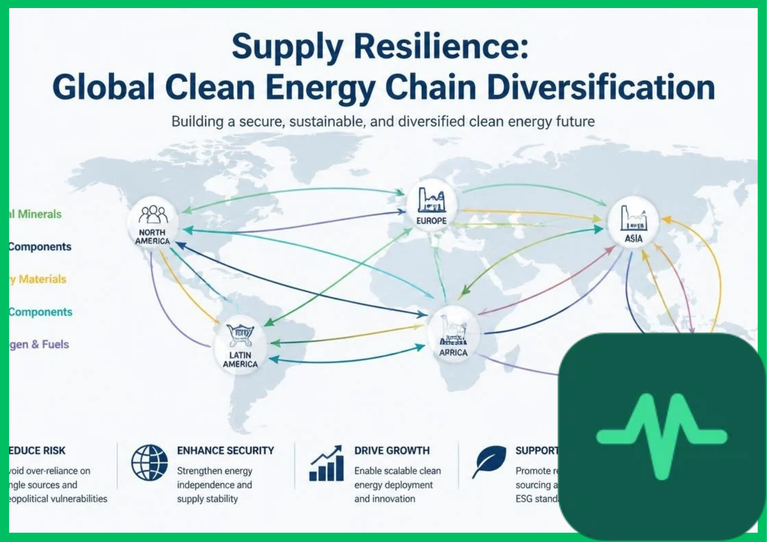
Upstream Extraction Constraints and Geological Grade Depletion
The foundational structural challenge governing clean energy supply chains is the lead time mismatch between rapid downstream technology deployment and upstream mineral extraction development. According to IEA market analyses, developing a new mining project from initial geological discovery to commercial ore production requires an average lead time of 12 to 16 years.
Clean energy technologies demand massive mineral inputs compared to fossil-fuel infrastructure. A standard battery-electric vehicle requires approximately six times the mineral mass of a conventional internal combustion engine vehicle, while an onshore wind installation demands triple the mineral volume per megawatt compared to natural gas power generation. As cumulative mining output scales rapidly, high-grade ore reserves experience progressive depletion. Mining operators are forced to process lower-grade mineral ores, requiring increased energy input per extracted metric ton, higher chemical reagent consumption, and expanded tailings management facilities.
Furthermore, upstream mineral extraction is highly concentrated. Australia dominates global lithium extraction via spodumene mining, Chile and Argentina control South American brine evaporation extraction, and the Democratic Republic of the Congo accounts for over 70% of global cobalt mine production. This geographical concentration exposes upstream material flows to local political instability, labor disruptions, and resource nationalism policies.
Midstream Refining Monopolies and Processing Bottlenecks
While upstream mining extraction presents localized vulnerabilities, midstream refining and chemical processing represent the most severe bottleneck in global clean energy supply chains. Raw mineral ores extracted from mines cannot be utilized directly in component manufacturing; they must undergo complex pyrometallurgical or hydrometallurgical refining to achieve battery-grade or semiconductor-grade purity thresholds ( ).
Midstream processing exhibits significantly higher geographical concentration than upstream extraction. According to IEA critical mineral data, China controls over 50% to 90% of global refining capacity for key energy transition metals, including nearly 100% of natural graphite and dysprosium, over 70% of cobalt, and approximately 60% of lithium and manganese. For battery-grade nickel, rapid capacity expansion in Indonesia has concentrated output among a few dominant suppliers.
This extreme midstream concentration creates systemic vulnerability. Because refining facilities involve capital-intensive chemical processing plants, strict environmental permitting requirements, and proprietary separation technologies, establishing diversified processing corridors requires substantial capital outlays. Capital costs for constructing processing infrastructure in newly diversified regions are approximately 50% higher than in established incumbent producing hubs, slowing global supply chain rebalancing.
Technical Data Specifications of Clean Energy Supply Chains
| Supply Chain Parameter | Engineering & Market Benchmark Standard |
|---|---|
| Average Mine Development Lead Time | 12 to 16 years from discovery to commercial production |
| EV vs. ICE Mineral Intensity Ratio |  higher mineral mass per vehicle |
| Refining Concentration (Top 3 Nations) | 82% to 86% average market share across core minerals |
| China Midstream Refining Dominance |  natural graphite and rare earths processing |
| Secondary Recycling Capacity Growth |  of global recycling additions located in China |
| New Project Capital Cost Premium |  higher in diversified regions vs. incumbents |
| Target Regional Self-Sufficiency Index | 20% to 40% domestic processing under strategic acts |
Manufacturing Localization Metrics and Component Supply Security
Moving downstream from midstream metal refining to component manufacturing—such as battery cell fabrication, photovoltaic wafer slicing, and permanent magnet assembly—reveals further localization challenges. Battery cell manufacturing capacity, cathode active material synthesis, and photovoltaic ingot pulling are dominated by Asian manufacturing hubs, leaving North American and European clean energy deployment dependent on imported sub-components.
To measure and improve supply security, governments and industrial analysts utilize manufacturing localization metrics and import dependency indices. Strategic legislative frameworks—such as the European Union's Critical Raw Materials Act—establish binding benchmarks for domestic supply chain resilience, targeting specific thresholds by 2030:
- Extraction Benchmarks: Sourcing at least 10% of annual raw mineral consumption from domestic extraction mines.
- Processing Benchmarks: Refining a minimum of 40% of annual domestic consumption within regional borders.
- Recycling Benchmarks: Recovering at least 25% of strategic raw materials from post-consumer end-of-life recycling streams.
Achieving these localization metrics requires coordinated public financing support, streamlined environmental permitting, and long-term industrial policy alignment to overcome initial capital expenditure barriers.
Secondary Material Recycling and Closed-Loop Circularity
Mitigating upstream and midstream supply vulnerabilities requires accelerating secondary material recycling and establishing closed-loop circular economies. As early commercial electric vehicles, utility-scale battery storage installations, and photovoltaic solar farms reach their 15- to 30-year operational end-of-life, secondary scrap generation provides an alternative domestic source of critical minerals.
Advanced hydrometallurgical recycling facilities extract high-purity lithium, cobalt, nickel, and copper from shredded battery black mass with recovery efficiencies exceeding 90%. However, secondary recycling cannot immediately satisfy surging clean energy demand because current scrap volumes are bound by historical installation rates from a decade ago. While cumulative mineral demand expands exponentially, available end-of-life recycling feedstock scales incrementally. Consequently, primary mining and diversified midstream refining remain essential components of global supply chain strategy for the next two decades.
Technological Substitution and Material Efficiency Innovations
Beyond geographical diversification and recycling, material science innovations and technological substitution mitigate critical mineral supply bottlenecks. Researchers are redesigning chemical compositions to eliminate or reduce vulnerable inputs:
- Cathode Chemistry Evolution: Transitioning from high-cobalt nickel-manganese-cobalt (NMC 811) chemistries toward cobalt-free lithium iron phosphate (
 ) and emerging sodium-ion battery architectures eliminates dependence on scarce cobalt and nickel reserves.
- Permanent Magnet Reductions: Developing synchronous reluctance motors and heavy rare-earth-free permanent magnets reduces reliance on critical dysprosium and neodymium elements.
By combining technological material substitution, secondary recycling scaling, and targeted international trade partnerships, the global clean energy sector can construct resilient, diversified supply chains capable of sustaining net-zero transition trajectories.

Comments (0)
Login to leave a comment.
No comments yet. Be the first to share your thoughts!