
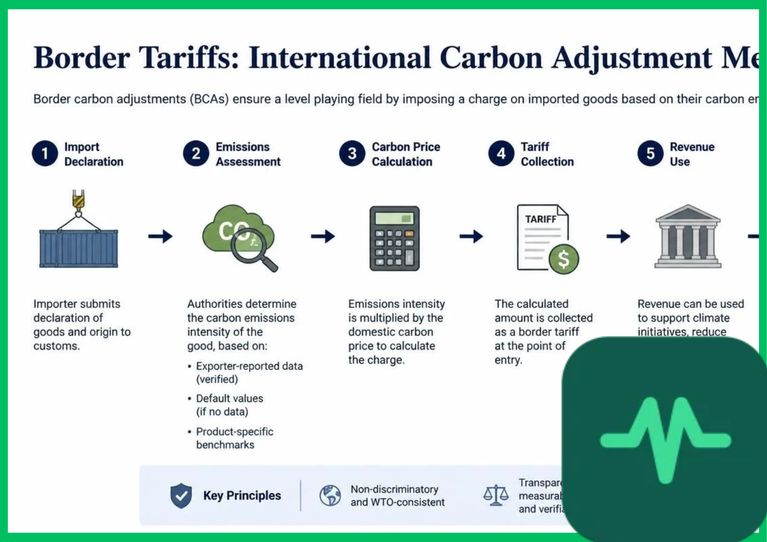
Embedded Carbon Metrics and Life Cycle Emissions Accounting
The foundational quantitative challenge governing carbon border adjustments is calculating total embedded carbon within traded industrial commodities. Embedded emissions comprise both direct process emissions generated on-site during chemical transformations and indirect emissions associated with the generation of electrical energy and thermal steam consumed during manufacturing.
Life cycle emissions accounting (LCEA) protocols quantify these footprints across three distinct scopes, focusing primarily on Scope 1 direct emissions and Scope 2 indirect energy emissions for heavy commodities such as crude steel, primary aluminum, cement clinker, mineral fertilizers, and hydrogen. Total embedded emissions ( ) per metric ton of manufactured product are calculated mathematically as:
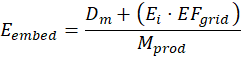
where  represents total direct process emissions (
 ),
 is consumed electrical energy (
 or
 ),
 is the carbon intensity of the regional electrical grid (
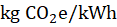 ), and
 is total mass output (
 ).
In primary steelmaking via the blast furnace-basic oxygen furnace (BF-BOF) route, embedded emissions average  of
 per ton of crude steel. Conversely, shifting production to direct reduced iron powered by green hydrogen (DRI-EAF) reduces embedded emissions below
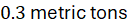 of
 per ton, demonstrating the direct quantitative impact of low-carbon engineering transitions.
Industrial Leakage Prevention and Competitiveness Parity
Imposing rigorous carbon pricing—such as emissions trading system (ETS) allowance costs ranging from  of
 —imposes severe operating cost burdens on domestic industrial manufacturers. If foreign competitors export identical commodities produced via high-emission fossil-fuel routes without bearing carbon costs, domestic market share collapses, driving industrial carbon leakage.
Carbon border adjustment mechanisms prevent carbon leakage by levying financial tariffs on imported commodities proportional to the carbon price differential between the exporting country and the importing jurisdiction. The financial tariff ( ) applied per metric ton of imported product is determined by the following formulation:

where  represents the carbon allowance price in the importing jurisdiction and
 is any verified carbon price paid in the country of origin. By neutralizing cost advantages derived from unpriced environmental externalities, carbon border adjustment mechanisms establish complete industrial competitiveness parity.
Technical Data Specifications of Carbon Border Adjustment Parameters
| Carbon Adjustment & Emissions Parameter | Engineering & Economic Specification Standard |
|---|---|
| Primary Steel Embedded Emissions (BF-BOF) |  of  per ton |
| Primary Steel Embedded Emissions (DRI-EAF) |  of  per ton via green hydrogen |
| Primary Aluminum Embedded Emissions |  of  per ton (smelting power) |
| Cement Clinker Calcination Emissions |  of  per ton of clinker |
| Carbon Price Benchmark Range |  of  equivalent |
| Emissions Accounting Scope Focus | Scope 1 (Direct process) and Scope 2 (Indirect electrical) |
| Default Value Penalty Multiplier | Conservative default emission factors penalizing unverified data |
Thermodynamic Realities of Hard-to-Abate Industrial Processes
Enforcing trade carbon tariffs requires accounting for the immutable thermodynamic and chemical realities governing heavy industrial production. In cement manufacturing, over 60% of total process emissions stem directly from the endothermic calcination of limestone ( ) into lime (
 ) and carbon dioxide (
 ) inside rotary kilns operating at
 to
 (
 to
 ):
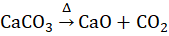
This chemical reaction is independent of fuel combustion efficiency. Similarly, primary aluminum smelting relies on the Hall-Héroult electrolytic reduction process, where alumina ( ) dissolved in molten cryolite (
 ) at
 (
 ) is reduced using carbon anodes. The carbon anodes oxidize during electrolysis, releasing direct process
 emissions alongside massive electrical energy consumption (
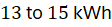 per kilogram of aluminum produced). Because these process emissions are chemically bound to primary material transformations, carbon border adjustment mechanisms compel global producers to adopt carbon capture and storage (CCS) or electrochemical reduction pathways to avoid punitive import tariffs.
Data Verification Protocols and Default Emission Penalties
A major operational challenge in implementing carbon border adjustments is verifying accurate embedded emission calculations across thousands of international supply chain facilities. Importers must submit certified emissions declarations audited by accredited third-party verification bodies.
If foreign producers fail to provide verified facility-specific primary data, regulatory authorities enforce conservative default emission factors. These default values are intentionally calibrated to the worst-performing 10% of manufacturing installations within the importing jurisdiction, imposing high financial penalty tariffs. This mechanism provides a strong economic incentive for international exporters to disclose transparent facility-level energy metrics, deploy continuous emissions monitoring systems (CEMS), and transition toward certified low-carbon manufacturing processes.
The Final Take
Mastering international carbon border adjustment mechanisms secures global industrial decarbonization by preventing carbon leakage and establishing transparent embedded carbon metrics. Citing IEA and UNEP assessments, aligning trade carbon tariffs with rigorous life cycle emissions accounting eliminates unpriced environmental externalities across heavy manufacturing supply chains. By enforcing regulatory compliance and verifying direct process emissions, carbon border adjustment frameworks establish an indispensable foundation for universal industrial net-zero parity.


Comments (0)
Login to leave a comment.
No comments yet. Be the first to share your thoughts!