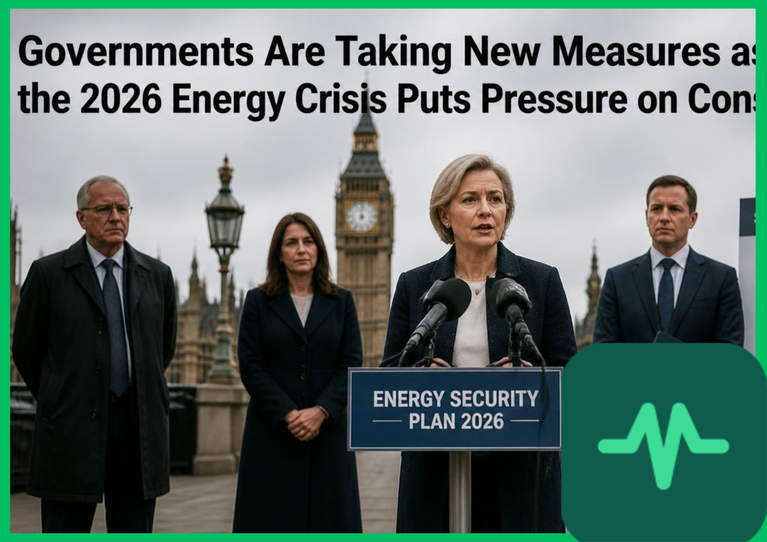
Energy markets are facing renewed disruption. As a result, governments are looking for ways to protect consumers while keeping energy supplies stable.
The response is not the same everywhere. Countries have different energy systems, economies and levels of dependence on imported fuels. Therefore, their policies also differ.
The International Energy Agency (IEA) has created a 2026 Energy Crisis Policy Response Tracker to document government actions taken in response to the disruption in global fuel markets. The tracker was last updated on 31 July 2026.
The tracker provides an important view of how governments are dealing with the current situation.
However, the 2026 energy crisis is about more than short-term prices. It could also influence energy policy, investment and clean technology.
Governments Are Responding to the 2026 Energy Crisis
Governments are using different measures to manage the 2026 energy crisis.
According to the IEA's tracker, government responses include actions designed to:
- Conserve energy
- Reduce fuel consumption
- Support households
- Support businesses
- Increase energy supply
- Improve energy security
- Address short-term price pressures
These measures show that governments are dealing with several problems at the same time.
First, consumers need affordable energy.
Second, businesses need reliable supplies.
Third, governments need to maintain energy security.
Finally, policymakers must consider what today's decisions mean for the future.
Because of these competing needs, there is no single response to the 2026 energy crisis.
Some governments may focus on helping households. Others may prioritise fuel supplies or energy conservation.
Some measures may last only for a short period. Others could influence energy policy for years.
Why Energy Prices Matter to Consumers
Energy prices affect almost every part of the economy.
When fuel prices rise, transportation can become more expensive. Businesses may also face higher operating costs.
In turn, those costs can affect the prices consumers pay for goods and services.
Households can also feel the pressure directly.
Higher electricity, heating or transport costs can reduce the amount of money available for other needs.
That is why governments often respond quickly when energy markets become unstable.
During the 2026 energy crisis, consumer protection has therefore become an important part of the policy response.
However, governments have limited resources.
Long-term subsidies can become expensive. Price controls can also create other market problems if they remain in place for too long.
As a result, policymakers must balance immediate support with longer-term energy reforms.
Energy Security Has Become More Important
The 2026 energy crisis also highlights the importance of energy security.
Energy security means having access to enough energy at an affordable price and with an acceptable level of reliability.
For countries that depend heavily on imported fuels, global market disruptions can create significant risks.
A sudden change in fuel supply can affect prices. It can also put pressure on businesses and consumers.
Therefore, governments may look for ways to reduce their exposure to external energy shocks.
That can include increasing domestic energy production, improving energy efficiency and diversifying energy sources.
What Does the Crisis Mean for Renewable Energy?
The 2026 energy crisis could create both challenges and opportunities for renewable energy.
When fuel prices become uncertain, domestic renewable resources can become more attractive.
Solar and wind do not require a continuous supply of imported coal, oil or natural gas to generate electricity.
Once a renewable-energy project is operating, its fuel source is naturally available.
That does not mean renewable energy is completely protected from market pressures.
Solar panels, wind turbines, batteries and other equipment depend on global supply chains.
Projects also require financing, grid connections and infrastructure.
Nevertheless, renewable energy can reduce some forms of fuel-price exposure.
For that reason, the 2026 energy crisis could encourage some governments to look more closely at renewable energy as part of their energy-security plans.
Energy Efficiency Could Become a Bigger Priority
Energy efficiency is another important part of the response. The cheapest energy is often the energy that does not need to be used.
Improving building efficiency can reduce heating and cooling needs. More efficient appliances can reduce electricity consumption.
Better industrial equipment can reduce energy use in factories. More efficient transport can also reduce fuel demand.
During the 2026 energy crisis, governments may therefore have a strong reason to encourage energy efficiency.
This can help consumers in the short term. At the same time, it can reduce energy demand over the longer term.
That makes energy efficiency different from some emergency measures. Instead of simply reducing the impact of high prices, efficiency can change how much energy people need.
Batteries Could Play a Larger Role
Energy storage is another technology worth watching.
Battery systems can store electricity when supply is high and release it when demand increases.
This can be useful when renewable energy is producing more electricity than consumers need at a particular moment.
For example, solar power can generate large amounts of electricity during the day. Batteries can store some of that electricity for later use.
Therefore, the 2026 energy crisis could increase interest in technologies that give electricity systems greater flexibility.
However, batteries are not a complete answer.
Countries still need strong electricity grids, diverse energy sources and good energy planning.
Electric Mobility Is Part of the Conversation
Electric vehicles can also become part of a broader energy-security strategy.
Electric cars do not use petrol or diesel directly. Instead, they use electricity.
If that electricity comes increasingly from domestic renewable sources, electric mobility can reduce dependence on imported transport fuels.
However, this transition takes time. Countries need charging networks. They also need reliable electricity supplies.
Consumers need affordable vehicles. Therefore, electric mobility is a long-term solution rather than a quick response to the 2026 energy crisis.
Energy Security and Sustainability Are Not the Same
There is an important distinction that policymakers need to understand. Energy security is not automatically the same as sustainability.
During a crisis, governments may prioritise immediate supply.
That can mean increasing the availability of conventional fuels or supporting consumers through temporary measures. Such actions may be necessary in an emergency.
However, they do not always support long-term climate goals. This creates a difficult policy challenge. Governments need to protect consumers today.
At the same time, they need to build energy systems that are cleaner, more resilient and affordable in the future.
The best policies should ideally address both goals.
The Crisis Could Change Investment Decisions
The effects of the 2026 energy crisis could extend beyond the immediate period of market disruption.
Businesses may reconsider their energy strategies.
Manufacturers may look for more secure supply chains.
Governments may increase domestic energy production.
Investors may pay greater attention to technologies that reduce exposure to fuel-price volatility.
Consumers may also become more interested in solar panels, batteries and energy-efficient appliances.
As a result, today's crisis could influence tomorrow's energy market.
What This Means for Us
The 2026 energy crisis demonstrates why energy policy and technology cannot be treated as separate subjects.
Government policy affects which technologies are developed and deployed.
At the same time, technology affects how quickly countries can respond to changes in energy supply and demand.
For example, a government may encourage households to reduce electricity consumption.
Smart energy-management technology can make that easier.
A government may also want to increase renewable electricity.
Solar, wind and battery systems can support that goal.
Similarly, a government seeking to reduce transport fuel consumption may encourage electric mobility.
Therefore, technology can give policymakers more options.
Africa Could Face Both Risks and Opportunities
The impact of the 2026 energy crisis will not be the same across Africa. Many African countries already face energy-access challenges. Others depend on imported fuels.
This can make global energy-market disruptions particularly important. At the same time, Africa has significant renewable-energy potential.
Solar power is particularly attractive in many regions. Wind, hydropower and other renewable resources can also contribute.
However, potential alone is not enough. Countries need investment. They need reliable electricity grids. They need affordable financing.
They also need policies that encourage long-term projects. If those conditions improve, energy crises could strengthen the case for domestic clean-energy investment.
The Long-Term Policy Question
The biggest question is what happens after the immediate crisis.
Emergency measures can protect consumers during periods of market pressure.
But governments also need to think beyond the current situation.
Will today's policies encourage more energy efficiency?
Will they increase renewable-energy investment?
Will they improve electricity grids?
Will they make energy systems more diversified?
Will they reduce dependence on volatile fuel markets?
These questions matter because energy infrastructure can last for decades.
A short-term policy decision can therefore have a long-term effect.
EcoGreenPusle View
The 2026 energy crisis is a reminder that energy policy is also technology policy.
Governments need to manage immediate problems.
However, they also have an opportunity to strengthen the systems that will protect consumers from future disruptions.
Renewable energy can reduce dependence on imported fuels.
Energy efficiency can reduce demand.
Batteries can improve flexibility.
Electric mobility can reduce dependence on petrol and diesel.
Smart energy systems can help consumers manage consumption.
None of these technologies can solve an energy crisis on its own.
Together, however, they can contribute to a more diverse and resilient energy system.
Conclusion
The 2026 energy crisis is putting governments under pressure as they try to protect consumers, maintain energy supplies and manage market disruption.
The IEA's 2026 Energy Crisis Policy Response Tracker shows that countries are using different approaches. These include energy-conservation measures, consumer support, efforts to increase supply and actions aimed at improving energy security.
In the short term, these measures may help households and businesses manage difficult market conditions.
In the longer term, however, the bigger question is whether the crisis will change how countries build their energy systems.
A stronger focus on renewable energy, energy efficiency, batteries, electric mobility and smart energy technology could reduce some risks in the future.
Therefore, the most important story may not be the emergency measures themselves.
It may be what governments do after the emergency.
If policymakers use the lessons of the 2026 energy crisis to build more efficient, diversified and resilient energy systems, today's disruption could help shape a more secure energy future.
Sources
International Energy Agency (IEA) — 2026 Energy Crisis Policy Response Tracker, last updated 31 July 2026.
Editorial note: This article is based on the information supplied from the IEA's policy-response tracker and presents additional editorial analysis around renewable energy, efficiency, storage and electric mobility. Company claims and government policy positions should be clearly attributed when additional sources are added.
Comments (0)
Login to leave a comment.
No comments yet. Be the first to share your thoughts!