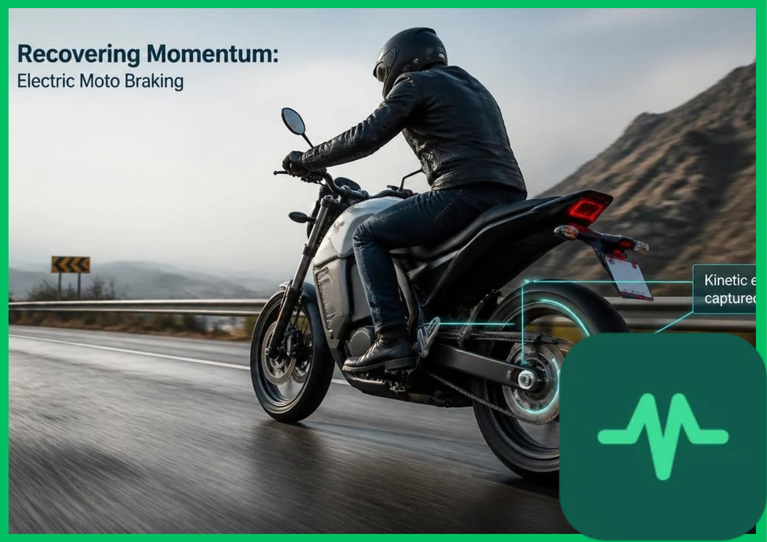
You feel the heavy machine slow down smoothly as you approach a sharp corner on a winding mountain road.
On a traditional gasoline motorcycle, that act of stopping wastes energy.
Friction brake pads clamp down hard onto metal rotors, turning all that forward momentum into waste heat that radiates uselessly into the surrounding air.
Every time you brake, precious energy vanishes into thin air.
For over a century, internal combustion motorcycles operated on that wasteful stopping rule.
We burned gasoline to build speed, and then we threw that energy away every time we tapped the brakes.
That inefficiency hurt our fuel economy and added to our fossil fuel addiction.
We cannot build a clean, sustainable future while letting our vehicles waste their own momentum.
What if every time you slowed down, your motorcycle captured that forward energy and fed it right back into the battery?
What if stopping could actually extend your riding range instead of draining it?
A quiet, brilliant electrical revolution is transforming two-wheeled transport across the globe.
According to global transport reports from the International Energy Agency (IEA), resource protection frameworks from the United Nations Environment Programme (UNEP), efficiency benchmarks from ENERGY STAR, and academic electric vehicle research, electric motorcycle regenerative braking systems are changing our riding landscape.
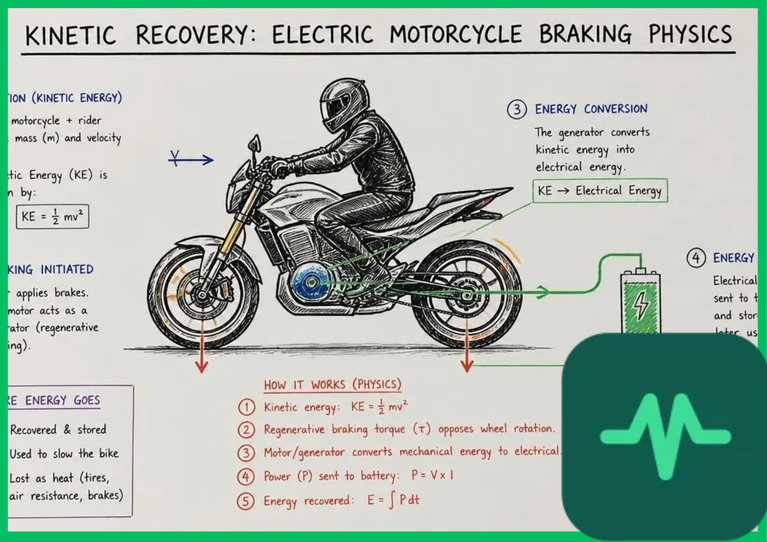
By running the electric motor in reverse during deceleration to capture kinetic energy and recharge the battery pack, we turn stopping power into fuel.
Here is how energy recovery works, why two-wheel kinetic recapture changes riding economics, and how recovering momentum secures our sustainable future.
The Wasteful Trap of Friction Braking
To understand why regenerative braking matters so much, you have to look at the physics of traditional motorcycle stopping.
When you accelerate a motorcycle to 100 km/h or 60 mph, you build up a massive amount of kinetic energy.
When you need to stop, traditional brake pads grab the wheel rotors.
The kinetic energy converts instantly into thermal energy through friction.
Metal rotors glow hot to the touch.
That energy is gone forever.
In heavy city traffic with constant stop-and-go riding, friction braking wastes up to 30% to 40% of the total energy stored in your vehicle's fuel or battery.
Skeptics once argued that electric motorcycles were just heavy toys with limited range that could never match the convenience of gasoline bikes.
Engineers and electric vehicle pioneers proved those skeptics wrong.
An electric motor can run in reverse.
When you let go of the throttle, the motor stops pulling the wheel and starts fighting it, acting as a powerful electrical generator that captures the bike's forward momentum.
What Is an Electric Motorcycle Regenerative Braking System?
An electric motorcycle regenerative braking system is an integrated motor-controller technology that reverses the electrical polarity of the drivetrain when the rider rolls off the throttle, turning the electric wheel motor into a generator that captures kinetic energy and pumps electrical current back into the battery pack.
Instead of wearing down brake pads every time you slow down, the magnetic resistance of the motor slows the motorcycle down for you.
The process operates through clean electromagnetic physics:
- Deceleration: You roll off the throttle or squeeze the brake lever gently.
- Polarity Reversal: The onboard motor controller instantly switches the stator windings from driving mode into generation mode.
- Kinetic Recapture: The forward momentum of the heavy motorcycle forces the rotor to spin against magnetic resistance, generating electricity.
- Battery Charging: That captured electrical current flows back through power cables and refills the lithium-ion battery cells.
You stop smoothly while packing extra miles of range back into your power source.
The Science of Kinetic Recapture and Battery Efficiency
How does reversing an electric motor turn a moving motorcycle into a mobile battery charger?
It comes down to electromagnetic induction and energy conservation laws.
Academic electric vehicle research shows that regenerative braking recovers up to 15% to 25% of total battery energy during typical urban riding conditions, extending overall riding range significantly between charges.
Furthermore, because the electric motor handles the majority of everyday slowing down, your physical friction brake pads experience almost zero wear.
Riders go years without needing a brake pad replacement.
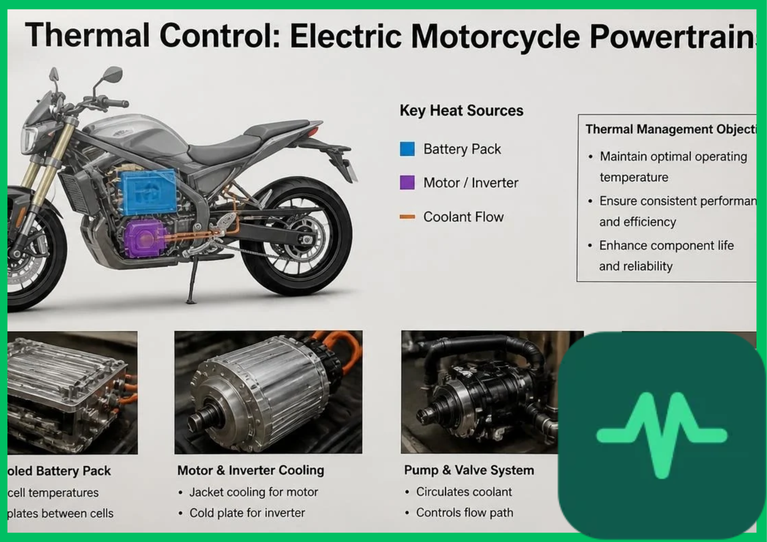
According to ENERGY STAR and international vehicle efficiency evaluations, advanced motor controllers regulate power conversion efficiency with high precision, ensuring that energy flows smoothly back into the cells without overheating the battery pack.
Efficiency improves, maintenance costs drop, and riding range expands.
Environmental Integrity and Urban Traffic Efficiency
The environmental benefits of regenerative braking extend far beyond saving money on brake pads or squeezing extra miles out of a battery charge.
They make electric motorcycles the ultimate clean urban commuter vehicle.
According to UNEP resource governance frameworks, replacing gasoline scooters and motorcycles with electric two-wheelers slashes city air pollution, eliminates deafening exhaust noise, and cuts greenhouse gas emissions dramatically across dense metropolitan areas.
When regenerative braking makes electric motorcycles more efficient and responsive to ride, everyday commuters feel confident leaving their cars behind.
According to IEA clean transport roadmaps, scaling up lightweight electric mobility is an essential pillar to decarbonize global transportation networks.
When every slowdown feeds energy back into the machine, sustainable travel becomes a closed-loop reality.
Overcoming Control Calibration and Rider Realties
Scaling regenerative braking systems from high-end electric superbikes into accessible everyday motorcycles involves navigating real-world control hurdles.
If a regenerative brake engages too abruptly when a rider rolls off the throttle, the rear wheel can slip on wet pavement.
Engineers solve this challenge by programming sophisticated, adjustable regenerative braking curves that let riders customize how aggressively the motor slows the bike down, pairing electrical deceleration smoothly with traditional hydraulic disc brakes.
As software intelligence improves and rider controls become more intuitive, regenerative braking is transitioning from an advanced racing feature into standard equipment on every electric motorcycle worldwide.
Recovering Our Momentum Toward a Sustainable Future
Electric motorcycle regenerative braking systems prove that human engineering can recapture energy that was once thought lost forever.
We no longer have to accept that stopping a vehicle requires burning away our forward momentum as waste heat in friction pads.
By turning electric motors into generators during deceleration, we recover kinetic energy and recharge our batteries on the fly.
We step away from wasteful transit, embracing a smart, efficient, and enduring standard of two-wheeled mobility.
Through brilliant electromagnetic engineering, rigorous academic research, and a deep respect for our shared environment, recovering momentum secures a clean, thrilling, and sustainable future for every rider on Earth.
Comments (0)
Login to leave a comment.
No comments yet. Be the first to share your thoughts!