
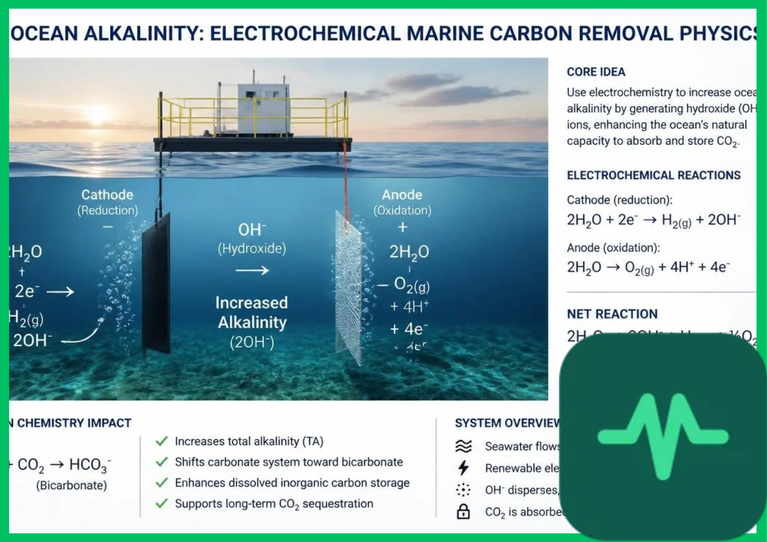
 emissions, yet that uptake lowers surface ocean pH and carbonate ion saturation. Electrochemical ocean alkalinity enhancement carbon dioxide removal increases surface seawater alkalinity without adding external mineral mining waste directly to marine habitats, shifting marine carbonate chemistry to draw down atmospheric
 while buffering ocean acidification. Evaluating seawater carbonate equilibrium, bipolar membrane electrodialysis, acid-base stream separation, and dissolved inorganic carbon flux is essential for analyzing electrochemical marine carbon removal physics.
Seawater Carbonate Equilibrium and Alkalinity Buffering
In surface seawater, total alkalinity ( ) measures the excess of proton acceptors (bases) over proton donors (acids) and governs how carbon partitions among aqueous species. Dissolved
 reacts with seawater to establish a coupled carbonate equilibrium system:

where  denotes combined aqueous
 and carbonic acid,
 is bicarbonate ion, and
 is carbonate ion. At typical surface ocean pH values (
 ) and temperatures of
 to
 (
 to
 ), bicarbonate dominates dissolved inorganic carbon (
 ), followed by carbonate and a small fraction of dissolved
 .
Raising surface total alkalinity—by adding hydroxide ( ) or removing hydrogen ions (
 )—shifts the equilibrium to the right, converting aqueous
 into bicarbonate and carbonate ions. Lowering aqueous
 partial pressure (
 ) at the sea surface below atmospheric equilibrium (
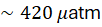 ) creates a thermodynamic driving gradient for net
 invasion from air into seawater while raising aragonite and calcite saturation states (
 ).
Bipolar Membrane Electrodialysis and Acid-Base Stream Separation
Electrochemical approaches generate alkalinity on site using electricity and seawater or brine rather than transporting vast quantities of crushed silicate or carbonate rock. Bipolar membrane electrodialysis (BPMED) stacks alternating cation-exchange membranes, anion-exchange membranes, and bipolar membranes—each consisting of a cation-exchange layer laminated to an anion-exchange layer—under an applied electrical potential.
Under reverse bias, water dissociation occurs rapidly at the bipolar membrane junction:

Generated  ions migrate through the cation-exchange layer toward the cathode side while
 ions migrate through the anion-exchange layer toward the anode side, enabling acid-base stream separation across compartments fed with seawater or desalination brine. The alkaline stream—enriched in sodium hydroxide (
 ) or magnesium hydroxide (
 ) precipitates when divalent magnesium ions (
 ) in seawater react with
 —can be discharged to raise surface ocean alkalinity.
Handling the co-produced acidic stream determines overall system viability. Acidifying seawater lowers pH and drives dissolved inorganic carbon toward volatile gaseous  , which can be stripped out as a concentrated
 gas stream for geological storage or utilization, or neutralized using alkaline minerals or industrial residuals so acidic effluent does not harm marine ecosystems at discharge outfalls.
Technical Data Specifications of Electrochemical OAE Systems
| Electrochemical OAE Parameter | Engineering & Biogeochemical Specification Standard |
|---|---|
| Core Separation Architecture | Bipolar membrane electrodialysis ( ) / electrolysis cells |
| Specific Electrical Energy Demand |  removed (architecture dependent) |
| Surface Seawater Operating Range |  to  (  to  ); salinity  |
| Power Rating Reference Basis |  ; modular  to multi-  stacks |
| Target Alkalinity Addition Ratio |  air-sea uptake |
| Primary Co-Product / Stream | Alkaline base effluent + acidic stream / concentrated  |
| Key Marine Biogeochemical Limit | Local pH /  ceiling to prevent runaway  precipitation |
Dissolved Inorganic Carbon Flux and Air-Sea Gas Transfer
Increasing surface alkalinity creates potential for  drawdown, yet actual dissolved inorganic carbon flux across the air-sea interface is rate-limited by physical gas transfer kinetics and ocean mixing. The net air-sea
 flux (
 ) scales with gas transfer velocity (
 ) and the partial pressure difference between air and surface water:

where  is the solubility coefficient of
 in seawater and
 is surface seawater
 fugacity/partial pressure. Gas transfer velocity (
 ) depends strongly on wind speed, surface roughness, wave breaking, and bubble entrainment, meaning surface waters with elevated alkalinity can advect away via currents or mix downward into deeper water layers before complete atmospheric equilibration occurs.
In addition, localized over-alkalinization or excessive pH spikes near a discharge outfall can trigger spontaneous calcium carbonate ( ) precipitation. Precipitating calcium carbonate releases
 back into solution and consumes two moles of alkalinity per mole of
 formed, counteracting carbon removal efficiency. Engineering diffusers, mixing zones, and dosing rates keep local pH and saturation states within safe bounds to preserve net alkalinity gain.
Membrane Fouling, Scaling, and Low-Carbon Power Coupling
Scaling electrochemical marine carbon removal requires controlling multi-valent ion scaling and membrane fouling in natural seawater. Seawater contains calcium ( ) and magnesium (
 ) ions alongside organic matter and microorganisms; high local pH inside alkaline compartments or cathodes precipitates calcium carbonate (
 ) and magnesium hydroxide (
 ), clogging membrane pores, increasing cell voltage, and raising electrical energy demand per tonne of carbon removed.
Pretreatment via ultrafiltration or nanofiltration, pulsed polarity or acid-wash cleaning, and scale-resistant membrane formulations mitigate fouling over extended duty cycles. Co-locating units with existing desalination outfalls or low-carbon electricity generation—such as offshore wind, solar, hydro, or nuclear power ( equals
 )—ensures net carbon negativity while monitoring local marine ecological impacts under rigorous environmental verification protocols.
Comments (0)
Login to leave a comment.
No comments yet. Be the first to share your thoughts!