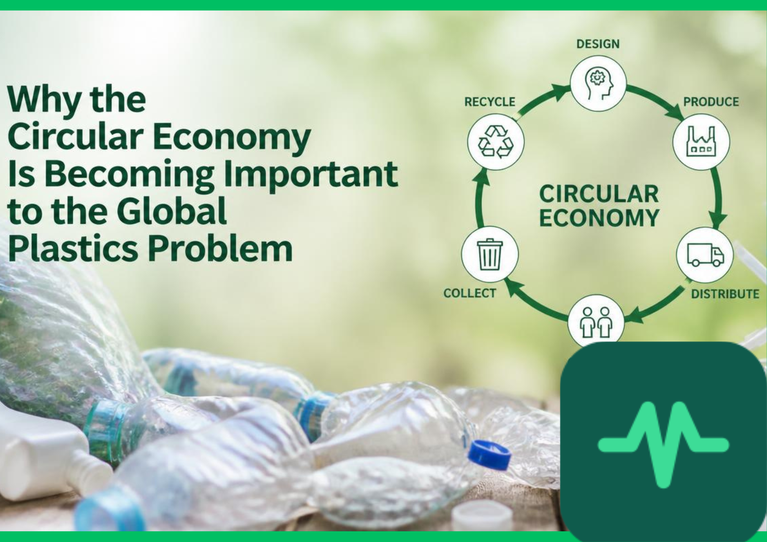
Much of the modern economy follows a simple model:
Take → Make → Use → Throw away.
This is known as a linear model. The circular economy proposes a different approach.
Products and materials should remain useful for as long as possible. That can mean using products again, repairing them, recycling materials or redesigning products to create less waste.
Plastics Show the Problem Clearly
Plastic is useful. It is lightweight. It is durable. It is cheap.
But those same characteristics can create environmental problems when products are designed for short-term use and then discarded. UNEP has argued for a shift toward a circular approach to plastics that focuses on reducing unnecessary plastic use, redesigning products and packaging, increasing reuse and improving recycling.
Recycling Is Only Part of the Answer
A common mistake is to treat recycling as the entire circular economy. It isn't. A stronger circular system can start before a product is manufactured.
Companies can ask: Can we use less material? Can we make the product last longer? Can the product be repaired? Can it be reused? Can its materials be recovered? These questions can reduce waste before recycling becomes necessary.
Product Design Matters
The design of a product can determine how sustainable it becomes. A product that is difficult to repair may be thrown away when a small component fails. A product designed with replaceable components may remain useful much longer.
Similarly, packaging can be redesigned to reduce unnecessary material.
Businesses Have a Major Role
Companies can help build circular markets. They can develop refill systems. They can create repair programmes. They can take back used products. They can use recycled materials.
They can also design products that are easier to disassemble. These changes can create new business models.
Consumers Also Matter
Consumers influence markets through purchasing decisions. Buying durable products can reduce replacement demand.
Repairing products can extend their useful life. Reusing products can reduce waste.
However, consumers cannot solve the problem alone. Product design and government policy also influence what choices are available.
Technology Can Help
Digital technology can support circular systems. Tracking systems can help companies understand where products are.
Digital product information can help identify materials. Data can help companies organise repair and reuse.
Artificial intelligence can potentially improve sorting and recycling processes.
Therefore, the circular economy is not simply a waste-management issue.
It is also a technology issue.
Africa and the Circular Economy
Circular business models could offer opportunities in African cities. Repair businesses are already important parts of many local economies.
Recycling businesses can create employment. Reuse systems can reduce material costs.
However, stronger infrastructure and investment are needed to scale these systems.
EcoGreenPulse Analysis
The biggest strength of the circular economy is that it changes the question.
Instead of asking:
“How do we dispose of this product?”
it asks:
“How can we design the product so that disposal is less necessary?”
That is a much broader approach.
Conclusion
The circular economy is becoming increasingly important because waste cannot be solved simply by improving disposal.
Products need to be designed differently. Materials need to remain useful for longer. Reuse and repair need to become easier. Recycling must also improve. Together, these changes could reduce resource use and environmental pressure.
Source: UNEP, Turning off the Tap: How the world can end plastic pollution and create a circular economy.
Comments (0)
Login to leave a comment.
No comments yet. Be the first to share your thoughts!