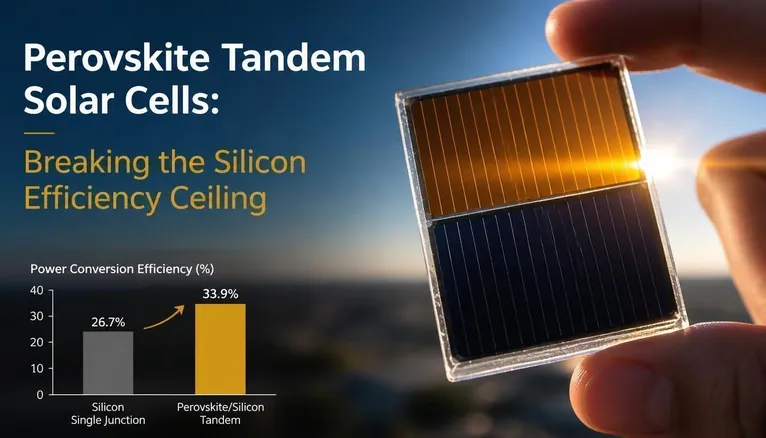
Silicon solar panels do a wonderful job. They brought clean electricity within reach for millions of people. Yet physics places a hard ceiling on how much power silicon alone can ever capture from sunlight. No matter how advanced the manufacturing gets, silicon simply cannot go much higher than about 22 to 29 percent efficiency.
This ceiling frustrated scientists for years. They knew more sunlight was hitting every panel than silicon alone could ever use. So much energy was slipping away, wasted as heat instead of electricity. That frustration eventually led to something genuinely hopeful: perovskite tandem solar cells.
In this guide, we will explore how perovskite tandem solar cells work. We will look at the physics behind their success. We will also look at the real challenges standing between this technology and your rooftop. By the end, you will understand why so many engineers feel excited about this next chapter in solar power.
Why Silicon Alone Was Never Going to Be Enough
Let's start with the core problem. Sunlight is not one simple thing. It contains a whole spectrum of light, from high-energy blue and ultraviolet rays down to lower-energy red and infrared light.
Silicon can only capture a narrow slice of this spectrum well. It handles red and infrared light reasonably well. But when powerful blue or ultraviolet light hits a silicon cell, most of that extra energy gets wasted, lost as heat instead of useful electricity.
This waste felt genuinely painful to watch, at least from a scientific perspective. So much clean, free sunlight pouring down every single day, yet silicon alone could never fully use it. This exact gap is what perovskite tandem solar cells were designed to close.
What Makes Perovskite Tandem Solar Cells Different
So what exactly are perovskite tandem solar cells? At their core, they combine two different materials working together as a team. A thin layer of perovskite crystal sits on top. Traditional silicon sits underneath.
Each layer has its own specialty. The perovskite layer captures high-energy blue light near the top of the panel. The silicon layer beneath captures the lower-energy red and infrared light that passes through. Together, these two layers cover far more of the light spectrum than silicon could ever manage alone.
This teamwork feels almost elegant. Instead of asking one material to do everything, perovskite tandem solar cells split the work intelligently. Each layer focuses on what it does best, working in quiet harmony to capture far more usable energy from the same beam of sunlight.
The Exciting Efficiency Numbers
Here is where the real excitement builds. Standard silicon panels typically convert only about 22 percent of sunlight into usable electricity in commercial settings. Perovskite tandem solar cells have already pushed past 33 percent efficiency in laboratory testing.
That jump might not sound huge at first glance, but it represents a massive leap in real-world terms. More efficiency means more power from the exact same rooftop or solar field. It means fewer panels needed to generate the same amount of electricity. It means faster payback times for homeowners and utility companies alike.
For an industry that spent decades squeezing out small, incremental gains, this kind of leap feels genuinely thrilling. Perovskite tandem solar cells are not a minor upgrade. They represent one of the most significant improvements in solar technology since panels first hit the market.
How the Physics Actually Works
It helps to understand exactly how perovskite tandem solar cells achieve this feat. Picture sunlight hitting the panel from above. The very first layer it encounters is the perovskite crystal.
This crystal is specially engineered, tuned precisely to absorb high-energy blue and visible light. Scientists can adjust the perovskite's chemical structure with remarkable precision, fine-tuning exactly which wavelengths it captures most efficiently.
Light that the perovskite layer does not need, mainly the lower-energy red and infrared wavelengths, passes right through it. Since the perovskite layer is semi-transparent, this leftover light continues downward, striking the silicon layer directly underneath.
The silicon layer, doing what it has always done well, captures this remaining light and converts it into electricity too. By splitting the workload this way, perovskite tandem solar cells manage to harvest far more of the total sunlight spectrum than either material could capture working alone.
The Real Challenge: Keeping Perovskite Alive
As exciting as this technology sounds, perovskite tandem solar cells face a serious, real-world obstacle. Perovskite crystals are surprisingly fragile compared to tough, reliable silicon.
Silicon can survive decades of brutal weather. Blistering desert heat. Freezing winter storms. Pounding rain. It barely flinches. Perovskite crystals, unfortunately, do not share this same resilience. They are highly sensitive to moisture. Even tiny amounts of humidity sneaking through a panel's outer glass can slowly break down the crystal structure.
This vulnerability feels frustrating, almost like discovering a beautiful solution with a hidden flaw. Heat and ultraviolet exposure create additional problems too, gradually causing the perovskite's chemical elements to separate over time. Left unprotected, these cells could fail long before the twenty-year lifespan that utility companies expect and require.
Fighting Back With Smart Engineering
Thankfully, engineers are not giving up easily on perovskite tandem solar cells. Instead, they are developing clever protective barriers to shield these delicate crystals from the outside world.
Advanced polymer encapsulation layers now seal perovskite cells away from moisture and air. Vacuum-sealed barriers add another layer of protection, keeping damaging elements locked out entirely. This careful engineering work feels a bit like protecting something precious and fragile, wrapping it carefully so it can survive the harsh realities of outdoor life for decades.
Every improvement in this protective technology brings perovskite tandem solar cells closer to real, widespread commercial use. Researchers know that raw efficiency numbers mean little if the panels cannot survive long enough to matter in the real world.
Where This Technology Is Headed
Right now, perovskite tandem solar cells remain mostly in pilot manufacturing and testing phases. Companies are carefully proving that these panels can survive real-world conditions before committing to massive, large-scale production.
This cautious approach makes sense. Nobody wants to install millions of dollars worth of panels, only to watch them fail years ahead of schedule. Still, the progress happening right now feels genuinely promising. Each successful durability test brings this technology one meaningful step closer to your rooftop or a nearby solar farm.
Utility-scale solar fields seem like an especially strong early target for perovskite tandem solar cells. Higher efficiency means less land needed to generate the same amount of power, a genuinely valuable advantage in regions where space is limited or expensive.
Why This Breakthrough Feels So Important
There is something deeply hopeful about watching an old physical limit finally get broken. For decades, silicon's ceiling felt like an unavoidable fact of life for the solar industry. Perovskite tandem solar cells prove that ceiling was never truly permanent, just waiting for the right combination of materials and clever engineering.
This matters enormously for the fight against climate change. More efficient solar panels mean faster, cheaper clean energy adoption worldwide. Fewer panels needed means lower material costs and less land disturbed by new installations. Every improvement compounds, pushing the entire renewable energy transition forward just a little bit faster.
For engineers who have spent years chasing incremental gains, perovskite tandem solar cells represent something rare and exciting: a genuine leap forward, not just another small step. That feeling of real progress carries real emotional weight for an industry that has worked so hard, for so long, toward a cleaner future.
Common Questions About Perovskite Tandem Solar Cells
Are perovskite tandem solar cells available for home use yet? Not widely. Most current production remains in pilot and testing phases, focused on proving long-term durability before large-scale commercial rollout begins.
Why are perovskite tandem solar cells more efficient than regular silicon panels? They use two layers instead of one, capturing a much wider range of the light spectrum. Perovskite captures high-energy blue light, while silicon underneath captures red and infrared light.
What is the biggest challenge facing perovskite tandem solar cells? Durability remains the main hurdle. Perovskite crystals are sensitive to moisture, heat, and UV exposure, requiring advanced encapsulation to protect them over a typical twenty-year lifespan.
When might perovskite tandem solar cells become widely available? Experts expect gradual commercial rollout over the coming years, as manufacturers refine encapsulation techniques and prove long-term reliability through extended field testing.
The Cost Question: Will This Technology Be Affordable?
Efficiency alone does not guarantee success. Cost matters just as much, and this is a real question mark hanging over perovskite tandem solar cells right now. Adding a second material layer naturally adds manufacturing complexity, and complexity often means higher upfront costs.
However, there is genuine reason for optimism here. Perovskite crystals can actually be manufactured using relatively simple, low-temperature processes compared to the energy-intensive methods required for pure silicon production. This means that, over time, perovskite tandem solar cells could become cheaper to produce than many people initially assumed, even with the added complexity of a second layer.
Manufacturers are also betting that higher efficiency will offset any extra production costs. Fewer panels needed to generate the same power means lower installation costs, less land required, and reduced mounting hardware. When you add up these savings across an entire solar project, perovskite tandem solar cells may end up delivering real financial value, even if the panels themselves cost slightly more per unit upfront.
Scaling From Lab to Factory Floor
Moving any technology from a research lab into mass production is never simple, and perovskite tandem solar cells are no exception. Laboratory conditions are carefully controlled, clean, and precise. Factory floors are messier, faster, and far less forgiving of small errors.
Manufacturers must figure out how to apply perovskite layers consistently across millions of panels, without introducing tiny defects that could shorten a panel's lifespan. This requires new equipment, new quality control processes, and plenty of trial and error before reaching truly reliable, large-scale production.
Several companies around the world are already racing to solve this manufacturing puzzle. Whoever cracks reliable, affordable mass production first stands to gain a massive advantage in the rapidly growing solar market. This competitive pressure is actually speeding up progress, pushing perovskite tandem solar cells toward commercial readiness faster than many analysts originally predicted just a few years ago.
Final Thoughts
Perovskite tandem solar cells represent something the solar industry has quietly hoped for across four decades of steady, incremental progress: a genuine breakthrough. By combining silicon's reliability with perovskite's remarkable light-capturing ability, this technology finally shatters a ceiling that once felt permanent.
Real challenges remain, especially around durability and long-term stability. Yet these feel like solvable engineering problems, not permanent roadblocks. Just like early solar technology once faced its own steep hurdles decades ago, perovskite tandem solar cells are steadily working through theirs today.
As encapsulation technology improves and pilot projects prove their worth, expect perovskite tandem solar cells to slowly but surely enter mainstream production. Each successful test brings this technology closer to rooftops, solar farms, and power grids around the world.
In the end, perovskite tandem solar cells offer something the world needs badly right now: real, tangible hope that solar power still has room to grow. That old silicon ceiling, once thought unbreakable, is finally giving way to something better.


Comments (0)
Login to leave a comment.
No comments yet. Be the first to share your thoughts!