For years, engineers watched sunlight pour down. They knew silicon alone could never use all of it. Physics set a firm ceiling. No matter how good the manufacturing got, silicon panels could never convert much more than 29 percent of sunlight into power. Meanwhile, real-world panels today sit even lower, closer to 22 or 24 percent.
This ceiling felt frustrating. So much free, clean sunlight was simply going to waste. Finally, perovskite-silicon tandem cells offer a real way past that wall. This single idea sits at the heart of everything perovskite-silicon tandem cells promise to change. In this guide, we will explore how perovskite-silicon tandem cells work. Next, we will look at the physics behind the breakthrough. We will also look at the real challenges standing between this technology and your rooftop. By the end, you will understand why so many engineers feel hopeful about this next chapter in solar power.
Why Silicon Alone Could Never Be Enough
Let's start with the core problem. Sunlight is not one simple thing. Instead, it carries many wavelengths. These range from powerful blue and ultraviolet light down to gentler red and infrared light.
Silicon only handles part of this spectrum well. It captures red and infrared light nicely. However, high-energy blue light mostly slips past it. It gets wasted as heat instead of electricity. This waste felt like a quiet tragedy to scientists. They understood exactly how much power was being lost.
So this exact gap is what perovskite-silicon tandem cells were built to close. Instead of asking one material to catch everything, this technology splits the job between two.
What Makes Perovskite-Silicon Tandem Cells Work
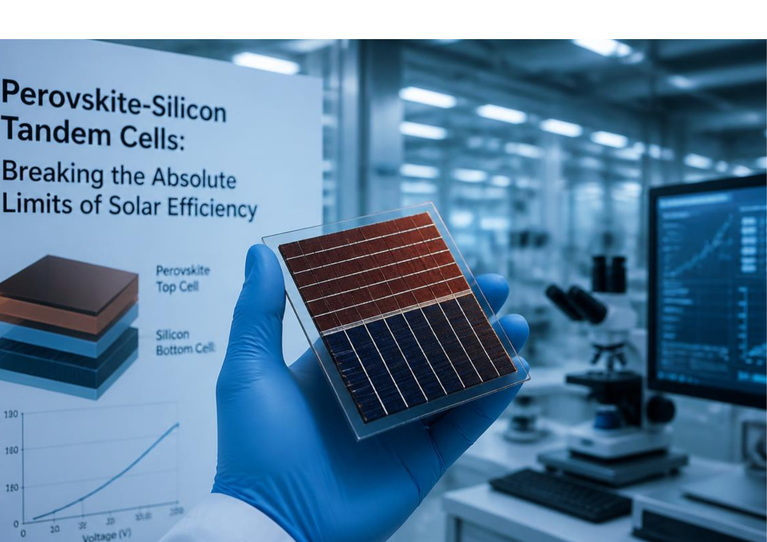
So what are perovskite-silicon tandem cells, really? They stack two materials together as a team. In fact, this stacking idea is the whole secret behind perovskite-silicon tandem cells. A thin perovskite layer sits on top. Silicon sits underneath.
Each layer plays to its strength. The perovskite layer up top grabs high-energy blue and green light. Meanwhile, the silicon layer below catches the red and infrared light that passes through. Together, they cover far more of the light spectrum than silicon could ever manage alone.
This teamwork feels genuinely elegant. Instead of forcing one material to do everything, perovskite-silicon tandem cells split the work smartly. Each layer focuses on what it does best. Together, they work quietly to pull more real power from the very same beam of sunlight.
The Exciting Numbers Behind This Breakthrough
Here is where the real excitement builds. Standard silicon panels physically cannot beat 29.4 percent efficiency. That is a hard law of physics. It is not just a manufacturing limit. Yet perovskite-silicon tandem cells blow straight past this number. The size of that leap is worth pausing on.
In lab testing, this technology has already reached a theoretical ceiling above 43 percent. Meanwhile, real commercial prototypes are already hitting 31 to 33 percent efficiency in stress tests today. That gap between old silicon and new tandem technology feels almost unbelievable.
More efficiency means more power from the same rooftop or solar field. It also means fewer panels needed for the same output. So for an industry that spent years chasing small, incremental gains, perovskite-silicon tandem cells represent something rare. They mark a true leap forward, not just another small step.
How the Layers Actually Split the Work
It helps to picture this process happening in real time. First, sunlight hits the panel at the top perovskite layer. This layer is carefully engineered to absorb high-energy blue and green light with real precision.
Next, light that perovskite does not need keeps moving. This is mostly the lower-energy red and infrared waves. It passes cleanly through. Since this top layer is semi-transparent, that leftover light keeps traveling downward, reaching the silicon layer waiting underneath.
Then silicon does what it has always done well. It captures this remaining light and turns it into electricity too. By dividing the job this way, perovskite-silicon tandem cells manage to harvest far more total sunlight than either material could capture working alone.
The Real Problem: Keeping Perovskite Alive
As exciting as this sounds, perovskite-silicon tandem cells face a serious, honest obstacle. Perovskite crystals are fragile. Silicon, on the other hand, can survive thirty brutal years of desert heat, freezing storms, and pounding hail without much trouble. Perovskite cannot claim that same toughness.
These delicate crystals struggle badly with moisture. Even tiny amounts of humidity sneaking through outer glass can slowly break the crystal structure apart. On top of that, heat and ultraviolet light cause additional damage. They gradually pull the material's chemical elements apart over time.
This fragility feels like discovering a beautiful idea with a hidden flaw. Early perovskite layers sometimes lost their light-harvesting power within just months of real-world exposure. Sadly, that is nowhere near good enough for a product meant to last decades on a rooftop.
Fighting Back With Smart Engineering
Thankfully, scientists are not giving up on perovskite-silicon tandem cells. Instead, they are building clever protective barriers. These shield the fragile crystals from the outside world. Every one of these fixes brings perovskite-silicon tandem cells one step closer to lasting durability.
For instance, advanced nano-encapsulation techniques now seal perovskite layers tightly away from moisture and air. Researchers are also swapping out unstable organic compounds inside the crystal. They use tougher, more stable elements like cesium instead. This careful chemistry work feels a bit like wrapping something precious and delicate. It protects the material so it can survive years of real outdoor weather.
As a result, every improvement in this protective technology brings perovskite-silicon tandem cells closer to real, lasting commercial use. After all, raw efficiency numbers mean little if the panels cannot survive long enough on a roof to actually matter.
When Might This Technology Reach Your Roof
Right now, perovskite-silicon tandem cells remain mostly in advanced lab testing and early prototype stages. Companies are working hard to prove these panels can survive real-world weather. This has to happen before they can commit to mass production. In short, this proving stage is where perovskite-silicon tandem cells earn their credibility.
Early utility-scale specialty modules are expected to reach the market around 2028 to 2029. This timeline might feel distant. Still, for a technology facing such a difficult durability challenge, steady progress feels genuinely encouraging.
Utility-scale solar fields seem like a strong early target for perovskite-silicon tandem cells. After all, higher efficiency means less land needed to generate the same power. That is a real advantage in regions where space runs short or costs run high.
Why This Breakthrough Feels So Meaningful
There is something deeply hopeful about watching an old physical limit finally crack open. For decades, silicon's ceiling felt like a permanent fact of solar power. Yet perovskite-silicon tandem cells prove that ceiling was never truly unbreakable. It was just waiting for the right combination of materials and patience. That single fact is why perovskite-silicon tandem cells feel so meaningful to the people working on them.
This matters enormously for the fight against climate change. More efficient panels mean faster, cheaper clean energy adoption everywhere. In turn, fewer panels needed means lower material costs and less land disturbed by new solar farms.
So for engineers who spent years chasing small, incremental gains, perovskite-silicon tandem cells offer something rare and genuinely exciting. This is real, measurable progress, not just another minor tweak.
Common Questions About Perovskite-Silicon Tandem Cells
Are perovskite-silicon tandem cells available to buy yet? Not widely. Most current work remains in lab testing and early prototype stages, with commercial deployment expected around 2028 to 2029.
Why are perovskite-silicon tandem cells more efficient than regular silicon panels? They use two layers instead of one, capturing far more of the light spectrum. Perovskite absorbs high-energy blue light, while silicon underneath captures red and infrared light.
What is the biggest challenge facing perovskite-silicon tandem cells? Durability remains the main hurdle. Perovskite crystals are sensitive to moisture, heat, and UV exposure, requiring advanced protective sealing to survive decades outdoors.
How much more efficient could this technology become? Lab results already point toward a theoretical ceiling above 43 percent, compared to silicon's hard limit of 29.4 percent.
The Manufacturing Puzzle Still Being Solved
Moving perovskite-silicon tandem cells from a careful lab bench into a busy factory floor is not simple. In fact, this jump from lab to factory is where many promising versions of perovskite-silicon tandem cells could stumble if not handled with care. Lab conditions are clean and controlled. Factory floors, however, move fast. They are far less forgiving of tiny mistakes.
So manufacturers must find a way to apply perovskite layers consistently across millions of panels. Even a small defect could reintroduce the same cracking and degradation problems that plagued earlier designs. This means new equipment is needed. New quality checks are needed too. Plenty of trial and error must happen before reliable, large-scale production becomes possible.
Several companies around the world are racing to solve this manufacturing puzzle first. Whoever manages to reliably mass-produce perovskite-silicon tandem cells first stands to gain a massive advantage in a rapidly growing solar market. As a result, this competitive pressure is actually speeding progress along, pushing perovskite-silicon tandem cells toward commercial readiness faster than many analysts expected just a few years ago.
What This Could Mean for Solar Costs
Cost matters just as much as raw efficiency here. Adding a second material layer naturally adds some manufacturing complexity. This complexity could raise the price of perovskite-silicon tandem cells, at least in the early years of production.
However, there is real reason for optimism. Perovskite crystals can often be manufactured using relatively simple, low-temperature methods. This differs from the energy-intensive processes silicon alone requires. Over time, this could help perovskite-silicon tandem cells become more affordable than early estimates suggest, even with the added complexity of a second layer.
Also, higher efficiency means fewer panels are needed to generate the same amount of power. In turn, fewer panels mean lower installation costs, less mounting hardware, and less land required for large solar farms. When these savings are added up across an entire project, perovskite-silicon tandem cells could deliver real financial value, even if individual panels cost slightly more upfront.
Final Thoughts
Perovskite-silicon tandem cells offer something the solar industry has quietly hoped for across decades of steady, incremental progress. That something is a genuine breakthrough. By combining silicon's reliability with perovskite's remarkable light-capturing power, this technology finally shatters a ceiling that once felt permanent. Indeed, few innovations in solar history carry the same weight as perovskite-silicon tandem cells do right now.
Real challenges remain, especially around durability and long-term stability. Yet these feel like solvable problems, not permanent roadblocks. Just like early solar technology once faced steep hurdles decades ago, perovskite-silicon tandem cells are steadily working through theirs today.
As protective coatings improve and prototypes prove their worth, expect perovskite-silicon tandem cells to slowly enter real, mainstream production. Each successful test brings this technology, and every future version of perovskite-silicon tandem cells, closer to rooftops and solar farms worldwide.
In the end, perovskite-silicon tandem cells offer something the world needs badly right now. That is real, tangible hope that solar power still has room to grow. That old silicon ceiling, once thought unbreakable, is finally giving way to something better. And perovskite-silicon tandem cells are leading that charge.


Comments (0)
Login to leave a comment.
No comments yet. Be the first to share your thoughts!