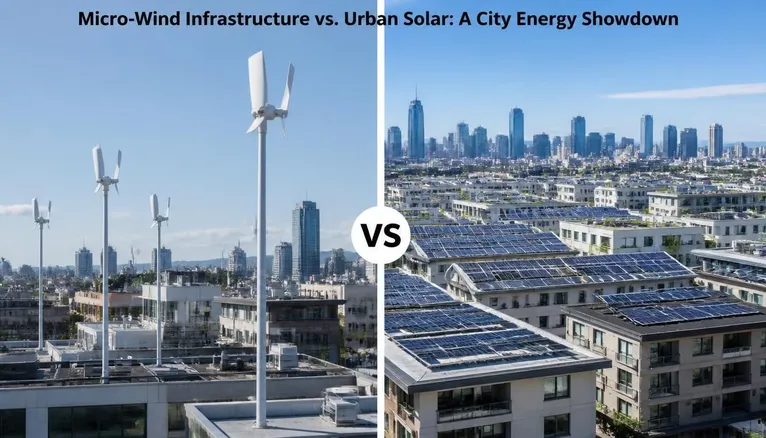
Out in the countryside, this problem barely exists. Wide fields welcome giant solar arrays. Open plains embrace towering wind turbines. But cities do not have that luxury. Every rooftop is crowded. Every wall is packed tight against another building. This is exactly why micro-wind turbines and urban solar had to evolve into something completely new.
In this guide, we will explore this exciting city energy showdown. We will look at how solar panels are changing shape entirely. We will look at how micro-wind turbines are learning to dance with chaotic city winds. By the end, you will understand why this quiet battle matters so much for the future of clean, livable cities.
Why Cities Break the Rules of Clean Energy
Let's start with the core challenge. Rural clean energy is simple. Land is cheap. Space is wide open. Cities flip this entirely upside down. Land is expensive. Space barely exists. Every rooftop already carries air conditioning units, elevator machinery, and maintenance hatches.
This tight squeeze forces engineers to think differently. They cannot simply shrink old rural technology and hope it works. Instead, they must reinvent it completely. This is exactly why micro-wind turbines look nothing like their giant countryside cousins. It is also why urban solar panels are hiding in places nobody would expect, like windows and building walls.
This struggle feels deeply relatable. Cities want to be cleaner. They want to fight climate change too. Yet their crowded geography keeps getting in the way. Thankfully, clever engineering is finally starting to close that painful gap.
Solar Power Gets a Dramatic Makeover
For years, solar power in cities felt stuck. Rooftops were simply too small and too crowded. A giant office tower might have thousands of square feet inside, yet its roof space barely fits a few solar panels.
This frustrating limit led to a breakthrough called Building-Integrated Photovoltaics, or BIPV. Instead of relying only on tiny rooftops, BIPV turns the entire outside of a building into a solar generator. Windows are coated with special photovoltaic layers that quietly absorb sunlight while still letting people see outside clearly.
Even building walls join the effort now. Thin, flexible solar laminates replace ordinary metal panels along a skyscraper's exterior. Suddenly, a single tower has thousands of square feet of solar-generating surface, not just a cramped rooftop.
This shift feels genuinely exciting. It transforms something as simple as sunlight bouncing off glass into real, usable electricity. Urban solar is no longer boxed in by rooftop limits. It has found a clever, beautiful way to spread across an entire building instead.
Micro-Wind Turbines Find Their Own Clever Trick
While solar spreads sideways across buildings, micro-wind turbines look upward, toward the rooftops themselves. There, engineers discovered something surprising, almost poetic. Skyscrapers create their own wind.
When strong wind hits a cluster of tall buildings, it gets pushed upward and squeezed tightly over rooftops. This creates fast, swirling wind tunnels high above the streets. Old-fashioned windmills cannot handle this kind of chaos. Their blades need steady wind blowing from one direction.
This is where micro-wind turbines truly shine. Many use a design called Vertical-Axis Wind Turbines, or VAWTs. These spin on an upright shaft, almost like a sculpture twisting gracefully in the breeze. Because of this shape, they can capture wind blowing from any direction at once. There is no need for complicated steering systems.
Some micro-wind turbines go even further, using specialized curved panels called Venturi cowlings. These panels grab passing wind and squeeze it, forcing the air to speed up before hitting the turbine blades. This clever trick means micro-wind turbines can generate meaningful power even during turbulent, unpredictable city gusts.
The Beautiful Advantage of Nighttime and Winter Power
Here is where micro-wind turbines offer something truly special. Solar panels need sunlight. Once the sun sets, their generation stops completely. Winter storms and cloudy skies only make this worse.
Micro-wind turbines do not share this weakness. Wind often blows strongest at night. Winter storms, which crush solar output, can actually boost wind generation instead. This creates a beautiful, natural balance between the two technologies.
When solar goes quiet, micro-wind turbines can quietly pick up the slack. This kind of teamwork feels reassuring. Cities relying on both systems together gain a steadier, more dependable stream of clean power, day and night, sunshine or storm.
The Emotional Trade-Off: Silence vs. Motion
Every technology has trade-offs, and this urban showdown is no exception. Solar panels are wonderfully quiet. They have no moving parts. Once installed, they sit calmly on a building, working silently in the background without disturbing a single tenant inside.
Micro-wind turbines cannot claim the same peaceful silence. They have spinning blades. That motion creates vibration. It can even create a low, steady hum that travels through a building's steel frame. For residents living just below a rooftop turbine, this hum can feel intrusive, even frustrating, if not handled carefully.
To fix this, engineers add special rubber mounts and dampening plates. These small parts absorb vibration before it disturbs anyone inside. This solution works well, but it adds cost. It also requires regular maintenance checks, something solar panels simply do not need.
This difference matters emotionally, not just technically. Silence brings comfort. But dependable nighttime power brings its own kind of comfort too, especially during a stormy winter evening when solar panels sit completely useless in the dark.
Where Each Technology Truly Shines
Neither solar nor micro-wind turbines are perfect on their own. Each one has a place where it clearly performs best. Understanding this helps cities choose wisely, rather than picking just one winner.
Urban solar shines brightest on glass-covered office towers. These buildings already have massive window surfaces, perfect for BIPV integration. Since offices are usually occupied during sunny daytime hours anyway, this pairing feels almost effortless.
Micro-wind turbines shine in different spots entirely. Coastal cities with strong, steady breezes are ideal candidates. Tall residential towers, bridges, and highway corridors with predictable wind patterns also make excellent homes for micro-wind turbines. In these locations, the extra noise and vibration concerns become far easier to manage.
Why Combining Both Feels Like the Smartest Path Forward
Rather than choosing sides, many city planners are embracing both technologies together. This combined approach feels genuinely hopeful. Solar covers the sunny daytime hours. Micro-wind turbines cover the dark, stormy nights when solar goes silent.
Together, they create a steadier, more reliable stream of clean power for an entire city. This partnership also protects cities from unexpected grid failures. If one power source dips unexpectedly, the other can help fill the gap.
This kind of teamwork mirrors something deeply human. No single solution solves every problem perfectly. But working together, even very different technologies like solar panels and micro-wind turbines can support each other beautifully, creating something stronger than either could achieve alone.
Common Questions About Micro-Wind Turbines and Urban Solar
Are micro-wind turbines loud? They can create some noise and vibration, though modern designs use dampening mounts to reduce this significantly. Solar panels remain the quieter option overall.
Can micro-wind turbines work on any building? Not every building is a good fit. Locations with strong, predictable wind patterns, like coastal areas or tall towers, tend to work best for micro-wind turbines.
Is urban solar as powerful as traditional solar farms? Not quite, but Building-Integrated Photovoltaics make up for limited space by covering much larger surface areas across windows and walls, boosting overall output.
Do cities really need both micro-wind turbines and solar power? Many experts believe so. Combining both technologies helps cover gaps, especially since micro-wind turbines perform well at night and during winter, when solar output drops.
Comparing the Costs
Cost matters a lot when cities decide between these two technologies. Urban solar generally wins on affordability and simplicity. Since panels have no moving parts, installation is often faster and cheaper. Maintenance costs stay low too, since there is little that can wear out or break over time.
Micro-wind turbines require a bigger upfront investment. Moving parts mean more engineering, more safety checks, and more ongoing maintenance. Vibration dampening systems add extra cost as well. However, this investment often pays off in locations with strong, steady wind, where micro-wind turbines can generate power around the clock, even through the night.
Over time, as demand grows and manufacturing scales up, prices for micro-wind turbines are expected to drop. This mirrors what happened with solar panels years ago, when early adoption costs were high before falling steadily as the technology matured.
The Role of City Planning and Policy
Technology alone cannot solve this puzzle. City planning and policy play a huge role too. Building codes must adapt to allow both urban solar and micro-wind turbines to be installed safely and efficiently.
Some cities already offer incentives for installing rooftop solar or micro-wind turbines. These programs help offset installation costs, making both technologies more accessible to building owners. As more cities recognize the value of decentralized power, expect these incentives to grow even further.
Zoning rules matter too. Some neighborhoods restrict rooftop structures for aesthetic or safety reasons, which can limit where micro-wind turbines are allowed. As the technology matures and proves its safety record, many experts believe these restrictions will loosen, opening the door to wider adoption across dense urban areas.
Final Thoughts
This city energy showdown does not really need a single winner. Urban solar and micro-wind turbines each bring something unique to crowded, complicated city skylines. One thrives in daylight. The other thrives in darkness and storms.
Together, they offer cities something precious: real energy independence. No longer must cities depend entirely on distant power plants or fragile regional grids. Instead, buildings themselves become quiet, resilient sources of clean power.
As more cities adopt both micro-wind turbines and advanced urban solar, this partnership will likely grow even stronger. Each new rooftop turbine and every sunlit window adds another small piece to a much bigger, hopeful picture.
In the end, this is not really a competition. It is a partnership, built one rooftop and one window at a time, quietly working to keep our cities powered, resilient, and just a little bit cleaner for everyone who calls them home.


Comments (0)
Login to leave a comment.
No comments yet. Be the first to share your thoughts!