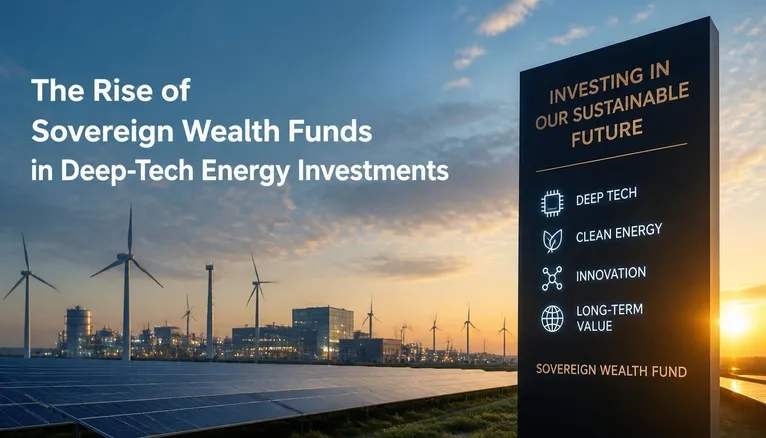
Software moves quickly. A small team can launch a product in months. Energy hardware moves at a completely different pace. A fusion reactor. A grid-scale battery. A hydrogen network. Each one takes years, sometimes decades, and hundreds of millions of dollars just to build a working prototype. Most investors cannot stomach that kind of wait.
This is exactly where sovereign wealth funds come in. These massive, state-backed pools of money do not answer to nervous shareholders demanding quick returns. They can wait. They can be patient. And in a world desperate for real climate solutions, that patience feels almost like a gift.
In this guide, we will explore why sovereign wealth funds matter so much right now. We will look at who is investing. We will look at what they are funding. We will look at why this quiet shift could shape the next fifty years of clean energy. By the end, you will understand why so many engineers and founders feel genuinely relieved to see sovereign wealth funds enter this space.
Why Regular Investors Cannot Fund the Future
Let's start with the core problem. Traditional venture capital works on a tight clock. Most funds expect an exit within seven to ten years. That timeline works beautifully for software. It works terribly for energy hardware.
Imagine trying to build a nuclear fusion reactor on a ten-year deadline. It simply does not work that way. Prototypes take years to design. Testing takes years more. Scaling up to commercial size can take a decade beyond that. Most investors panic long before real progress happens.
This mismatch has quietly starved deep-tech energy of the capital it desperately needs. Brilliant ideas sat stuck in labs, unable to grow, simply because nobody could fund a twenty-year journey. This gap felt discouraging for years. Engineers had the ideas. They just did not have the patient money to match them.
Sovereign wealth funds finally offer real hope here. Unlike typical investors, they operate on horizons stretching twenty to thirty years. That kind of patience feels almost unheard of in modern finance. Yet it is exactly what deep-tech energy has needed all along.
What Exactly Are Sovereign Wealth Funds?
So what are sovereign wealth funds, in simple terms? They are massive pools of money owned by national governments. Some come from oil profits. Others come from trade surpluses or national savings. Either way, these funds often manage trillions of dollars combined.
Unlike a typical investment firm, sovereign wealth funds do not need to please anxious clients every quarter. They answer to a nation's long-term interests instead. This freedom lets them think in decades, not quarters. It lets them fund projects that feel too risky or too slow for almost anyone else.
This distinction matters enormously. Sovereign wealth funds are not chasing quick wins. They are building toward a future that might not fully arrive for twenty years. That kind of long-view thinking is rare, and it is exactly what deep-tech energy breakthroughs require to succeed.
Oil Money Funding a Cleaner Future
Here is where the story gets genuinely fascinating, even a little poetic. Many of the largest sovereign wealth funds come from oil-rich nations. Countries across the Middle East built massive wealth from fossil fuels. Now, some of that same money is quietly funding the clean energy transition.
This is not driven by environmental passion alone. It is driven by survival instinct. These nations know oil will not last forever, at least not as their primary source of wealth. Sovereign wealth funds allow them to convert temporary oil riches into something permanent: ownership stakes in the technologies that will power the next century.
By investing in hydrogen companies, battery manufacturers, and electric vehicle startups, these funds are quietly securing a seat at tomorrow's table. It is a clever, almost emotional kind of foresight. Rather than clinging to a fading industry, these sovereign wealth funds are choosing to help build what comes next, even if that future eventually replaces the very oil that built their wealth in the first place.
Filling the Terrifying "Valley of Death"
Every energy startup faces a brutal, frightening stage. It is often called the "valley of death." A company builds a working prototype in the lab. Everyone celebrates. Then reality hits hard. Scaling that prototype into a real, commercial-sized facility costs an enormous amount of money.
Banks will not lend against unproven technology. It feels too risky for them. Venture capitalists, even excited ones, often cannot write checks large enough to fund heavy machinery and massive concrete pours. Many brilliant companies have quietly died right here, stuck between promising lab results and the terrifying cost of scaling up.
Sovereign wealth funds are stepping directly into this dangerous gap. Their massive scale lets them write the kind of enormous checks needed for a first commercial pilot plant. Whether it is a green steel factory in northern Europe or a modular nuclear reactor trial in North America, sovereign wealth funds are providing the capital that keeps these projects alive during their most vulnerable moment.
This support feels like a genuine lifeline for struggling founders. Years of hard work, sleepless nights, and quiet fear about running out of funding suddenly gain real hope. Sovereign wealth funds are not just investors here. In many cases, they are the difference between a breakthrough reaching the real world or dying quietly in a lab.
Where the Money Is Flowing
It helps to look at exactly where sovereign wealth funds are placing their bets. Long-duration grid batteries are a major focus. These systems store renewable energy for hours or even days, helping stabilize power grids as more wind and solar come online.
Nuclear fusion is another exciting target. For decades, fusion felt like a distant dream, always "twenty years away." Sovereign wealth funds are helping change that timeline, funding the kind of long, expensive research that fusion has always required.
Hydrogen networks are drawing serious investment too. Building pipelines, storage tanks, and production facilities takes massive upfront capital. Sovereign wealth funds are uniquely positioned to fund this kind of heavy, patient infrastructure work.
Beyond the Middle East, other regions are joining this movement as well. Nordic state reserves are investing steadily in clean technology. Asian national wealth funds are doing the same, recognizing that early investment today could mean serious economic advantage decades from now.
Why This Feels Like More Than Just Money
There is something emotionally powerful about watching sovereign wealth funds step into this role. For years, brilliant scientists and engineers worked on ideas that felt permanently out of reach, simply because nobody could fund the long journey required.
Now, that story is slowly changing. Fusion researchers who once doubted they would see their reactors reach commercial scale in their lifetime are feeling real, cautious hope again. Battery scientists who watched promising prototypes stall for lack of funding are seeing new pilot plants finally break ground.
This shift matters beyond spreadsheets and investment terms. It represents patience finally being rewarded. It represents long, difficult scientific work finally getting the support it deserves. Sovereign wealth funds are not just filling a financial gap. They are restoring a sense of possibility to an entire generation of energy innovators.
The Strategic Side of Patient Capital
Of course, sovereign wealth funds are not acting purely out of goodwill. There is a clear strategic logic behind their patience. Nations backing these funds want secure, diversified economies for the decades ahead. They do not want to be caught unprepared as the world shifts away from fossil fuels.
By investing early in deep-tech energy, these funds are positioning their nations for long-term relevance. If nuclear fusion eventually succeeds, early investors stand to gain enormous influence over that technology. If hydrogen becomes a dominant global fuel, early stakeholders benefit enormously from that shift.
This blend of strategy and patience makes sovereign wealth funds uniquely powerful. They are not gambling recklessly. They are calmly, deliberately positioning themselves for a future they believe is coming, whether or not the rest of the market agrees yet.
The Risks Hiding Behind the Optimism
It would be unfair to paint this shift as flawless. Sovereign wealth funds carry real risks too, and honesty matters here. Some of these funds answer to governments with complicated political motivations. Investment decisions are not always purely economic.
There are also concerns about influence and control. When a single sovereign wealth fund holds a massive stake in a critical energy technology, questions naturally arise about who truly controls that innovation's future. Smaller nations and private companies sometimes worry about becoming overly dependent on a handful of powerful state investors.
Still, despite these valid concerns, the overall impact of sovereign wealth funds on deep-tech energy has been largely positive so far. Projects that would have died from lack of funding are surviving and scaling. Technologies once considered fantasy are inching closer to reality, one patient investment at a time.
What This Means for the Future of Clean Energy
Looking ahead, the influence of sovereign wealth funds is likely to keep growing. As traditional venture capital continues struggling with long hardware timelines, these patient, powerful funds will likely fill an even bigger share of the gap.
This could reshape who controls the next era of energy technology entirely. Instead of Silicon Valley startups racing on tight venture timelines, national wealth funds may increasingly set the pace, funding slower, deeper, more ambitious projects that private markets simply cannot stomach alone.
For everyday people, this shift might feel distant and abstract. Yet its effects will eventually reach daily life directly. Cheaper batteries. More reliable grids. Real progress toward commercial fusion. All of these outcomes depend heavily on capital patient enough to fund decades of hard, unglamorous engineering work, exactly the kind of capital sovereign wealth funds are uniquely built to provide.
Common Questions About Sovereign Wealth Funds
Why are sovereign wealth funds better suited for energy investment than venture capital? Sovereign wealth funds operate on much longer timelines, often twenty to thirty years. This patience matches the slow, expensive development cycles required for major energy hardware breakthroughs.
Which regions have the largest sovereign wealth funds investing in clean energy? Middle Eastern funds are among the most active, alongside Nordic state reserves and several major Asian national wealth funds.
Do sovereign wealth funds only invest in oil-related industries? No. Many are actively diversifying away from fossil fuels, investing heavily in batteries, hydrogen, and nuclear fusion to secure long-term economic relevance.
Are there risks involved with sovereign wealth funds funding critical energy technology? Yes. Political motivations and concerns about influence over key technologies are valid concerns. Still, many experts view their overall impact on deep-tech energy as largely positive.
Comparing Sovereign Wealth Funds to Traditional Investors
It helps to see these differences laid out clearly. Traditional venture capital moves fast. It chases quick exits. It thrives on hype cycles and rapid scaling. This works beautifully for apps, software platforms, and consumer products that can launch in months.
Sovereign wealth funds operate on an entirely different rhythm. They move slowly and deliberately. They are comfortable waiting years before seeing meaningful returns. This slower pace once seemed like a weakness in modern finance. Now, it looks more like a rare and valuable strength.
Banks sit somewhere in between, but even they hesitate around unproven hardware. Loans require collateral and predictable repayment schedules. Deep-tech energy projects rarely offer either in their early years. This leaves sovereign wealth funds as one of the few remaining sources of capital truly built for this kind of patient, high-risk, high-reward investment.
This contrast matters because it explains why sovereign wealth funds have become so essential, almost by default. It is not that other investors do not care about clean energy. Many genuinely do. It is simply that their financial structures were never designed to support such a long, uncertain journey.
Real-World Examples Bringing This Trend to Life
Consider a company working on next-generation grid batteries. In its earliest years, the technology exists only in small lab prototypes. Traditional investors hesitate, worried about a decade-long path to profitability. Sovereign wealth funds, however, see something different. They see a technology that could reshape entire national power grids within twenty years, a timeline that fits perfectly within their investment horizon.
Or consider a fusion startup working toward a working commercial reactor. For decades, fusion attracted plenty of scientific excitement but very little serious capital, since private investors could not justify funding something so far from commercial reality. Sovereign wealth funds have started closing that gap, treating fusion not as a fantasy, but as a long-term national strategic asset worth nurturing carefully over many years.
These examples highlight something important. Sovereign wealth funds are not just writing checks randomly. They are carefully selecting technologies that align with long-term national interests, whether that means energy independence, economic diversification, or simple technological leadership on the world stage.
Final Thoughts
Sovereign wealth funds are quietly reshaping how the world funds its clean energy future. What once felt like an impossible funding gap, one that left brilliant ideas stranded in labs for years, is slowly closing thanks to patient, strategic capital.
This shift carries real emotional weight for the scientists and engineers who have waited years for a real chance to prove their work at scale. Sovereign wealth funds are giving that chance back to them, one pilot plant, one prototype, one patient investment at a time.
As traditional venture capital continues to struggle with the slow pace of hardware innovation, sovereign wealth funds are stepping confidently into the gap. Their patience, once seen as unusual in modern finance, may end up being exactly what the world needed all along.
In the end, sovereign wealth funds represent something rare and hopeful: capital willing to wait for real, lasting change instead of chasing quick returns. That patience alone could end up quietly powering the next fifty years of clean energy progress.



Comments (0)
Login to leave a comment.
No comments yet. Be the first to share your thoughts!