 ), nitrogen oxides (
 ), and particulate matter (
 ), driving stringent international regulatory frameworks. Establishing mandatory zero-emission vehicle (ZEV) sales targets requires rigorous technical alignment across fleet electrification metrics, battery mass penalties, high-power Megawatt Charging System (MCS) infrastructure, and well-to-wheel lifecycle emissions accounting.
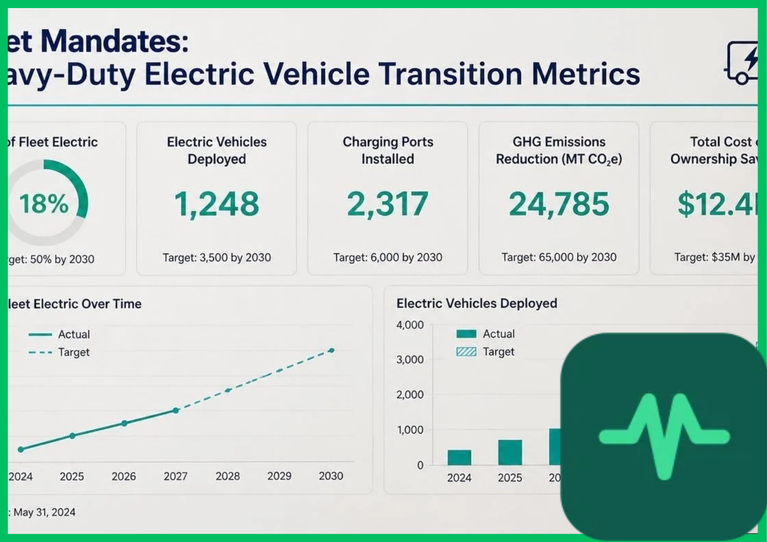
Commercial Fleet Electrification Targets and Regulatory Compliance Metrics
Global transportation decarbonization relies on standardized regulatory compliance metrics that mandate progressive sales shares for zero-emission commercial trucks. International policy benchmarks established by global energy accords require medium and heavy-duty truck manufacturers to achieve zero-emission sales thresholds of 30% by 2030 and 100% by 2040.
These regulatory mandates enforce strict fleet-average  intensity reduction targets, measured in grams of
 emitted per ton-kilometer (
 ). Commercial fleet operators failing to comply with phased regulatory milestones face substantial financial penalties or mandatory operational restrictions within urban low-emission zones. Compliance verification requires automated telematics reporting and standardized test procedures—such as the World Harmonized Vehicle Transient Cycle (WHVTC)—to quantify real-world energy consumption and powertrain efficiency across diverse duty cycles.
Battery Capacity Demands and Payload Weight Penalties
Transitioning Class 8 heavy-duty freight trucks from internal combustion engines to battery-electric propulsion systems introduces severe mass and volume constraints governed by electrochemical storage physics. Long-haul freight operations require continuous driving ranges exceeding  to
 (
 ), necessitating massive on-board battery pack capacities ranging from
 to over
 (
 ).
The gravimetric energy density of current commercial lithium-ion battery chemistries—such as nickel-manganese-cobalt ( ) and lithium iron phosphate (
 )—ranges between
 and
 (
 ). Consequently, a
 battery pack imposes a structural deadweight penalty between
 and
 (
 ). This substantial mass penalty reduces the allowable cargo payload capacity under legal maximum gross vehicle weight rating (GVWR) limits (
 [
 ] in many global jurisdictions). Engineering lightweight chassis architectures, high-voltage structural battery packs (cell-to-pack configurations), and advanced composite materials is mandatory to preserve commercial payload efficiency.
High-Power Megawatt Charging System (MCS) Infrastructure Metrics
Replenishing multi-megawatt-hour battery packs within mandated driver rest intervals requires ultra-fast charging infrastructure capable of delivering electrical power far exceeding standard passenger vehicle chargers. Conventional passenger vehicle DC fast chargers ( to
 ) would require multi-hour charging durations that disrupt commercial freight logistics.
International standardization bodies have codified the Megawatt Charging System (MCS) architecture to support high-power commercial vehicle replenishment. The MCS standard operates across specific electrical parameters:
- Voltage Architecture: High-voltage DC bus operation ranging from
 to
 DC.
- Electrical Current Delivery: Continuous current output up to
 (
 ).
- Power Output Capacity: Maximum power delivery scaling from
 up to
 per charging stall.
Transmitting  of electrical current generates extreme ohmic resistance heating (
 ) within charging cables and connector pins, necessitating active liquid-cooled umbilical cables and automated robotic positioning systems to ensure operator safety and thermal stability.
Technical Data Specifications of Heavy-Duty EV Parameters
| Heavy-Duty EV & Infrastructure Parameter | Engineering Specification Standard |
|---|---|
| Class 8 Battery Pack Capacity Range |  to  (  scale) |
| Battery Gravimetric Energy Density |  to  (  ) |
| Megawatt Charging System (MCS) Voltage |  to  DC high-voltage bus |
| MCS Maximum Current Delivery | Up to  (  ) continuous load |
| Heavy-Duty Energy Consumption Rate |  to  (  ) |
| Maximum Gross Vehicle Weight Rating |  (  ) nominal legal limit |
| Vehicle-to-Grid (V2G) Inverter Rating |  to  bidirectional power flow |
Well-to-Wheel Lifecycle Emissions Standards and Carbon Accounting
Evaluating the true environmental impact of heavy-duty electric vehicle mandates requires comprehensive well-to-wheel (WTW) lifecycle emissions accounting, rather than relying solely on tailpipe emissions metrics. Well-to-wheel analysis partitions carbon accounting into two distinct phases:
- Well-to-Tank (WTT): Quantifies upstream greenhouse gas emissions generated during primary raw material extraction, critical mineral refining, battery cell manufacturing, and electrical grid generation supplying the charging infrastructure.
- Tank-to-Wheel (TTW): Measures direct operational emissions during vehicle propulsion, which equals zero for battery-electric vehicles operating on renewable energy.
Life-cycle assessments published by the IEA and UNEP confirm that while manufacturing heavy-duty electric trucks incurs higher upfront embodied carbon than diesel internal combustion trucks due to battery mineral extraction, zero tailpipe emissions enable battery-electric fleets to achieve net carbon payback within 1.5 to 3 years of commercial operation, depending on the carbon intensity of the local electricity grid.
Total Cost of Ownership (TCO) Parity and Energy Efficiency
Commercial fleet operators evaluate vehicle procurement decisions based strictly on total cost of ownership (TCO) models rather than initial purchase price differentials. Heavy-duty electric trucks incur higher capital expenditures (CapEx) driven by battery pack costs, but achieve significantly lower operational expenditures (OpEx).
Energy efficiency metrics highlight the thermodynamic advantage of electric propulsion over internal combustion. While heavy-duty diesel engines achieve a maximum brake thermal efficiency of 40% to 45% under optimal load, electric traction motors and wide-bandgap silicon carbide ( ) inverters achieve electrical-to-mechanical conversion efficiencies exceeding 90%. Specific energy consumption rates for fully loaded Class 8 electric trucks range from
 to
 (
 ). Factoring in lower scheduled maintenance requirements—eliminating oil changes, exhaust after-treatment servicing, and multi-speed mechanical transmission repairs—commercial fleets achieve TCO parity with diesel trucks as battery costs decline below
 .
The Final Take
Mastering heavy-duty electric vehicle transition metrics establishes the rigorous technical and economic framework required to decarbonize global commercial freight networks. Citing International Energy Agency transport outlooks and UNEP environmental assessments, enforcing zero-emission mandates requires overcoming battery mass penalties, deploying Megawatt Charging System infrastructure, and optimizing well-to-wheel lifecycle emissions. By aligning regulatory compliance metrics with advanced powertrain engineering, commercial transport accelerates toward absolute greenhouse gas neutrality.




Comments (0)
Login to leave a comment.
No comments yet. Be the first to share your thoughts!