
 via lithium intercalation into
 , constraining pack gravimetric and volumetric energy density as automakers pursue longer driving ranges and faster charging. Elemental silicon (
 ) offers a theoretical specific gravimetric capacity of
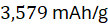 at room temperature (
 [
 ]) by forming intermetallic lithium-silicide alloys up to
 (or
 at elevated temperatures), yet pure silicon expands volumetrically by roughly
 to
 upon full lithiation. Unbuffered volume swings pulverize active particles, rupture surface films, and accelerate capacity fade. Evaluating volumetric expansion buffering, solid electrolyte interphase fracture, and fast-charge lithium plating is essential for analyzing silicon-carbon composite anode lithium-ion swelling mechanics.
Volumetric Expansion Buffering and Alloying Mechanics
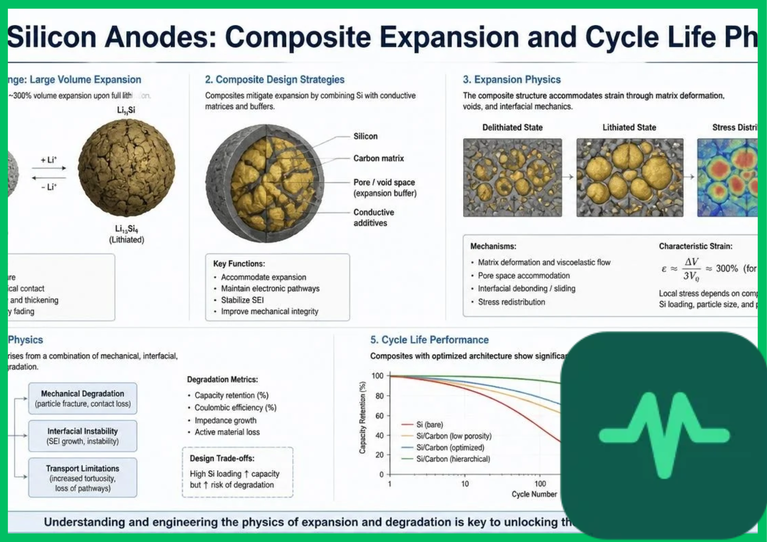
The high gravimetric capacity of silicon stems from multi-electron alloying rather than intercalation into layered interstitial galleries. Each silicon atom can host up to 3.75 to 4.4 lithium ions depending on temperature and phase state, storing roughly ten times the charge per unit mass of graphite. However, accommodating dense lithium atoms inside the silicon crystal lattice drives large lattice strain and volume expansion ( ), followed by severe contraction during delithiation.
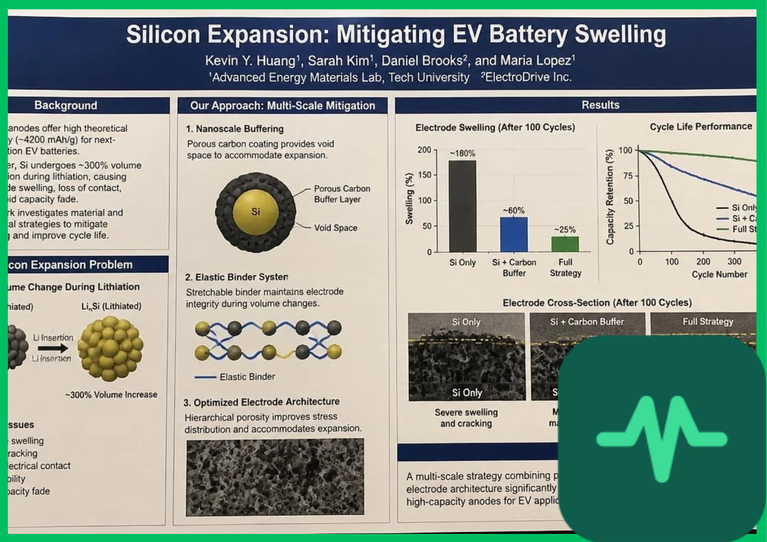
When silicon particles expand and contract repeatedly, mechanical hoop and shear stresses exceed the fracture toughness of brittle crystalline or amorphous silicon, triggering particle cracking, pulverization, and loss of electrical contact with conductive carbon additives and current collectors. Linear volumetric strain ( ) relates to dimensional expansion across constrained or unconstrained domains:

where  ,
 , and
 represent principal strains along orthogonal axes. Engineering silicon-carbon composite anodes resolves bulk swelling through volumetric expansion buffering: dispersing nano-sized silicon particles (
 diameter) or silicon-oxide (
 ) phases within porous carbon scaffolds, carbon nanotubes, or graphene cages. Below a critical particle size threshold (
 for crystalline silicon), fracture energy exceeds strain energy release rate during lithiation, suppressing crack propagation while internal void space in porous carbon accommodates expansion without pushing electrode thickness outward excessively.
Solid Electrolyte Interphase Fracture and Active Lithium Loss
A primary degradation pathway in high-silicon anodes is continuous solid electrolyte interphase (SEI) fracture and regeneration. During initial formation cycles, organic carbonate electrolytes—such as ethylene carbonate ( ) and dimethyl carbonate (
 ) containing lithium hexafluorophosphate (
 ) salt—reduce at low anode potentials (
 vs.
 ) to form an organic-inorganic passivating SEI layer.
In conventional graphite anodes, volume change during lithiation is modest ( ), keeping the SEI relatively intact after initial formation. In silicon-carbon composites, large volume expansion stretches and fractures the brittle SEI film on exposed silicon surfaces. Fresh metallic or alloyed silicon surfaces then contact liquid electrolyte directly, driving continuous electrolyte reduction, thickening an insulating SEI layer, consuming active cyclable lithium inventory, and increasing interfacial charge-transfer impedance.
Mitigating solid electrolyte interphase fracture requires combining tailored electrolyte additives—such as fluoroethylene carbonate ( ) or vinylene carbonate (
 ) that form more elastic, lithium-fluoride-rich (
 ) interphases—with elastomeric or self-healing polymer binders (such as cross-linked polyacrylic acid or alginate networks) and void-engineered carbon hosts that limit surface area exposure during cycling.
Technical Data Specifications of Silicon-Carbon vs. Graphite Anodes
| Anode Parameter |  Composite Anode | Conventional Graphite Anode |
|---|---|---|
| Theoretical Specific Capacity | 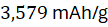 (  );  composite |  (  stoichiometry) |
| Dominant Storage Mechanism | Alloying ( ) + graphitic intercalation | Layered interstitial intercalation |
Pure  Lithiation Expansion |  volume change (  ) |  volume change (  ) |
Typical Composite  Content |  to  (higher in niche cells) |  (or trace  blend) |
| Thermal Operating Envelope |  to  (  to  ) cell pack |  to  (  to  ) cell pack |
| Primary Aging Failure Modes | SEI fracture, pulverization,  trapping | SEI growth,  plating at cold/fast charge |
| Pack Energy Density Impact | Raises cell/pack  and  | Mature baseline cost and cycle stability |
Fast-Charge Lithium Plating and Kinetic Constraints
High-rate charging introduces competing kinetic constraints on silicon-carbon composite anodes. While silicon offers high gravimetric capacity, solid-state lithium diffusivity inside silicon and thick composite electrodes can become rate-limiting under high C-rates ( to
 ), especially at low ambient or cell temperatures (
 to
 [
 to
 ]).
When charging current exceeds solid-state diffusion and charge-transfer kinetics at the anode surface, local anode potential approaches or drops below  versus
 . Under these conditions, fast-charge lithium plating occurs as metallic lithium deposits onto the electrode surface or carbon host instead of alloying cleanly into silicon. Plated metallic lithium can form high-surface-area mossy structures or react irreversibly with electrolyte ("dead lithium"), accelerating capacity loss and raising safety risks if dendritic growth penetrates separators.
Controlling electrode tortuosity, optimizing porosity and areal loading ( ), maintaining uniform cell compression pressure, and pairing silicon-carbon anodes with pulse-charging or temperature-aware charging protocols reduce polarization overpotentials and suppress metallic lithium plating during fast charging.
Cell-Level Trade-Offs and Industrial Scaling Realities
Adding higher silicon fractions to a composite anode improves specific gravimetric capacity and cell-level energy density, yet introduces first-cycle coulombic efficiency losses from initial SEI formation and trapped lithium within newly formed silicide phases. Because lithium inventory inside a sealed cell is finite—supplied primarily by the cathode—uncompensated first-cycle lithium loss reduces usable cell capacity unless offset by pre-lithiation strategies or excess cathode capacity.
Cell designers also account for pack-level mechanical constraints: even with nano-structuring and carbon buffering, composite anodes with elevated silicon content expand more than pure graphite electrodes, requiring module frames and busbar interconnects designed to accommodate controlled stack swelling without over-compressing jellyrolls or pouch stacks. Balancing silicon weight fraction, porous carbon architecture, and binder chemistry enables practical energy density gains while preserving cycle life across demanding duty cycles.

Comments (0)
Login to leave a comment.
No comments yet. Be the first to share your thoughts!