
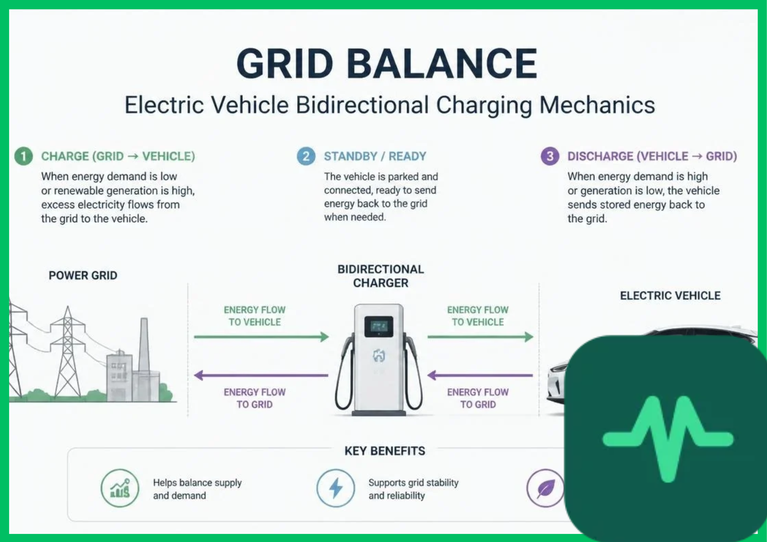
 to
 capacity) to discharge electrical energy back into residential dwellings or municipal distribution grids. Analyzing four-quadrant power conversion, frequency droop control, and electrochemical aging mechanisms is essential for evaluating bidirectional charging efficiency.
Four-Quadrant Inverter Topologies and Power Conversion Physics
The foundational electrical engineering principle governing bidirectional charging is four-quadrant power conversion. A conventional unidirectional electric vehicle charger rectifies alternating current (AC) from the municipal grid into regulated direct current (DC) to charge the traction battery pack, operating exclusively within Quadrant I (motoring/charging). In contrast, a bidirectional onboard or offboard charger utilizes advanced power electronics topologies—such as dual-active-bridge (DAB) DC-DC converters combined with active-front-end (AFE) inverters—that operate across all four quadrants of the voltage-current plane.
During vehicle-to-grid discharge cycles, stored direct current energy from the lithium-ion traction battery ( to
 DC) is inverted back into a synchronized multi-phase alternating current waveform (
 to
 AC,
 or
 ). Wide-bandgap silicon carbide (SiC) semiconductor switches operating via high-frequency space-vector pulse-width modulation (SV-PWM) maintain round-trip DC-to-AC power electronic conversion efficiencies exceeding 92% to 95%. These power electronic systems regulate active power (
 ) and reactive power (
 ) independently, stabilizing local grid voltage profiles without incurring excessive semiconductor thermal dissipation losses.
Frequency Regulation Response and Synthetic Inertia
As fossil-fueled synchronous generators are retired, municipal power grids face declining rotational inertia, increasing vulnerability to frequency deviations during sudden load imbalances or generation trips. Bidirectional electric vehicle charging infrastructure addresses this grid stability deficit by delivering sub-second primary frequency response and synthetic inertia.
Smart charging management systems monitor local grid frequency continuously. When regional electrical frequency drops below nominal thresholds ( or
 ), the bidirectional inverter detects phase angle displacement and injects active electrical power into the distribution grid within 100 milliseconds.
Frequency droop control governs this dynamic response, formulated mathematically as:
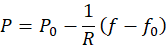
where  represents discharged power output,
 is baseline power,
 is the droop regulation coefficient,
 is instantaneous grid frequency, and
 is nominal reference frequency. This rapid injection arrests frequency decay faster than traditional mechanical turbine governors, providing vital ancillary services to distribution system operators.
Technical Data Specifications of Bidirectional Charging Parameters
| Bidirectional Charging Parameter | Engineering Specification Standard |
|---|---|
| Power Electronic Conversion Efficiency | 92% to 95% DC-to-AC inverter efficiency |
| Nominal Operating Voltage Range |  to  DC battery bus architecture |
| Grid Frequency Response Time |  primary droop response |
| Vehicle-to-Grid Power Transfer Rate |  to  AC (Residential / Commercial) |
| Semiconductor Switching Technology | Silicon Carbide (SiC) MOSFET active-front-end inverters |
| Target Battery Cell Chemistry | Lithium Iron Phosphate ( ) / High-Nickel NMC |
| Cycle Life Degradation Threshold | Controlled DoD limits to preserve battery warranty |
Electrochemical Battery Degradation and Throughput Kinetics
A primary engineering constraint surrounding vehicle-to-grid deployment is the potential acceleration of electrochemical battery degradation caused by supplementary charge-discharge cycling. Lithium-ion traction battery lifespan is governed by cumulative throughput ampere-hours, operating temperature, and depth of discharge (DoD) extremes.
Every additional equivalent full cycle (EFC) executed during V2G power export induces incremental mechanical stress within graphite anodes and cathode crystal lattices, accelerating solid electrolyte interphase (SEI) layer growth and capacity fade. However, advanced smart charging algorithms mitigate degradation by prioritizing Vehicle-to-Home (V2H) backup during peak tariff intervals and limiting V2G export to shallow depth of discharge windows (maintaining state-of-charge between 30% and 80%). Furthermore, maintaining battery core temperatures within optimal thermal thresholds ( to
 [
 to
 ]) via liquid cooling loops during high-power discharge events suppresses parasitic chemical aging kinetics.
Communication Protocols and Cybersecurity Architecture
Executing reliable vehicle-to-grid power transfer requires standardized communication protocols between the electric vehicle, charging station, and grid operator. International standards—specifically ISO 15118—govern high-level digital communication via Power Line Communication (PLC) over the charging cable.
ISO 15118 enables secure bidirectional data exchange, allowing the vehicle management system to transmit real-time battery health telemetry, state-of-charge limits, thermal parameters, and energy pricing schedules directly to the smart charger. Simultaneously, cryptographic security certificates and Transport Layer Security (TLS) encryption protect the communication link against unauthorized cyber intrusion, preventing malicious grid interference or unauthorized access to vehicle power electronics.
Economic Value Streams and Total Cost of Energy Ownership
Evaluating the commercial viability of bidirectional charging requires analyzing total cost of energy ownership and ancillary service revenue streams. Vehicle owners participating in managed V2G programs export stored electrical energy during high-demand evening peak pricing intervals or purchase electricity to charge vehicle batteries during low-cost renewable generation surges (arbitrage).
According to IEA smart grid economic evaluations, aggregated fleets of bidirectional electric vehicles form virtual power plants (VPPs) capable of offsetting local substation capacity upgrades and deferring utility infrastructure capital expenditures. By monetizing frequency regulation and peak shaving services, V2G architecture reduces net vehicle ownership costs while accelerating power grid decarbonization.


Comments (0)
Login to leave a comment.
No comments yet. Be the first to share your thoughts!