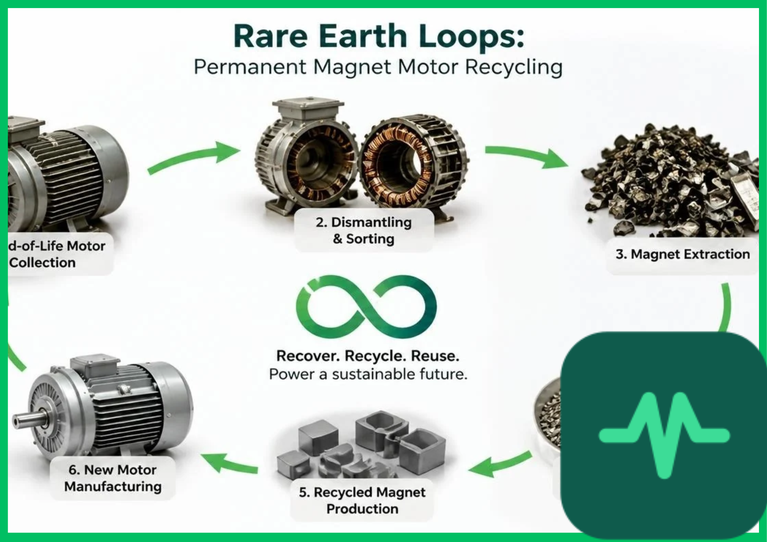
 ) permanent-magnet synchronous motors (PMSMs). According to International Energy Agency (IEA) critical mineral security assessments and academic metallurgical literature, global electric vehicle adoption requires surging supplies of Neodymium (
 ), Praseodymium (
 ), Dysprosium (
 ), and Terbium (
 ). Traditional traction motors utilize sintered
 magnets to achieve high power density, torque output, and operating efficiency. However, primary mining and chemical refining of rare earth elements generate massive acidic wastewater streams and radioactive thorium tailings. Reclaiming high-purity rare earth alloys from decommissioned electric vehicle drivetrains via hydrogen decrepitation, thermal processing, and hydrometallurgical refining establishes a sustainable circular supply chain, reducing primary extraction dependencies by up to 60%.
Metallurgical Composition and Thermal Demagnetization Physics
High-performance permanent-magnet synchronous motors rely on sintered  rotor magnets engineered with trace dysprosium or terbium additions to enhance high-temperature coercivity and prevent thermal demagnetization under aggressive load cycles. The chemical matrix comprises a primary
 tetragonal crystalline grain structure surrounded by a rare-earth-rich grain boundary phase.
Recovering these elements from end-of-life motor assemblies requires dismantling the rotor structure and separating bonded magnet tiles from electrical steel rotor laminations. Heating the rotor assemblies above the Curie temperature of the  alloy—typically ranging between
 and
 (
 to
 )—destroys the permanent magnetic alignment, eliminating attractive forces and simplifying mechanical extraction of the magnet segments.
Direct mechanical removal is frequently supplemented by thermal debonding furnaces operating at  to
 (
 to
 ) to decompose epoxy resin adhesives used to secure magnet tiles within rotor core slots.
Hydrogen Decrepitation (HDDR) and Solid-State Processing
Once separated from the steel laminations, bulk magnet scrap undergoes hydrogen decrepitation (HD), a solid-state metallurgical process that exploits the chemical affinity of rare earth elements for hydrogen gas. Exposing  magnets to pressurized hydrogen gas at ambient temperatures (
 to
 [
 to
 ]) and pressures ranging from
 to
 (
 to
 ) initiates an exothermic hydriding reaction.
Hydrogen atoms diffuse rapidly into the rare-earth-rich grain boundary phase, forming brittle rare earth hydrides ( ). This interstitial absorption expands the crystal lattice volume by up to 5% to 8%, generating localized internal mechanical stresses that shatter the bulk magnet block into a fine, friable rare earth alloy powder within minutes.
Following hydrogen decrepitation, heating the powder under a dynamic vacuum at  (
 ) drives off the hydrogen, yielding a reactive metallic powder ready for direct powder metallurgy upcycling or hydrometallurgical dissolution.
Hydrometallurgical Refining and Selective Solvent Extraction
While hydrogen decrepitation produces high-purity alloy powder for direct magnet re-synthesis, severely oxidized or contaminated magnet scrap requires full hydrometallurgical refining to separate individual rare earth elements from iron, cobalt, and nickel impurities. Hydrometallurgical processing commences with acid leaching of pulverized magnet scrap in concentrated hydrochloric acid ( ) or sulfuric acid (
 ) solutions.
The chemical dissolution reaction converts solid rare earth metals into soluble trivalent aqueous ions ( ):


Following filtration to remove insoluble boron and carbon residues, the multi-component leach liquor undergoes multi-stage countercurrent solvent extraction (SX). Organic extractants—such as di-(2-ethylhexyl) phosphoric acid (D2EHPA) or 2-ethylhexyl phosphonic acid mono-2-ethylhexyl ester (P507)—selectively bind target rare earth ions based on ionic radius differences across the lanthanide series. Adjusting aqueous phase acidity sequentially separates neodymium, praseodymium, and heavy dysprosium fractions, yielding high-purity rare earth oxides ( ) with purities exceeding 99.9%.
Technical Data Specifications of Permanent Magnet Recycling Parameters
| Metallurgical & Chemical Parameter | Engineering Specification Range |
|---|---|
Curie Temperature ( Alloy) |  to  (  to  ) |
| Thermal Debonding Temperature |  to  (  to  ) |
| Hydrogen Decrepitation Pressure |  to  (  to  ) |
Acid Leaching Concentration ( ) |  to  aqueous solution |
| Solvent Extraction Purity Yield |  rare earth oxide (REO) grade |
| Direct Sintering Compaction Pressure |  to  (  ) |
| Embodied Energy Reduction | 50% to 70% energy savings vs. primary mining |
Direct Magnet Scrap Upcycling and Powder Metallurgy
Direct recycling approaches bypass chemical breakdown entirely by re-melting or re-sintering recovered rare earth powders, preserving existing crystalline grain configurations and minimizing chemical reagent consumption. Recovered  powders generated via hydrogen decrepitation are blended with small additions of virgin neodymium or dysprosium to compensate for oxidation losses during motor operation.
The blended powder undergoes magnetic alignment inside a high-intensity magnetic field ( ) to orient crystal easy-axes, followed by isostatic pressing under hydraulic pressures between
 and
 (
 to
 ). Sintering the compact green bodies in a vacuum furnace at
 to
 (
 to
 ) achieves full densification. Subsequent heat treatment restores coercivity and magnetic energy products (
 ), yielding recycled permanent magnets that match the performance metrics of virgin raw materials.
Life-Cycle Assessments and Circular Economy Realities
Quantitative life-cycle assessments (LCAs) published by the UNEP, IEA, and academic metallurgical research institutes confirm that permanent magnet recycling reduces cumulative energy demand by 50% to 70% and cuts greenhouse gas emissions by over 60% compared to open-pit rare earth mining and solvent refining. Furthermore, closed-loop metallurgical processing eliminates radioactive waste generation associated with processing monazite and bastnäsite ores. As automotive manufacturers scale electric vehicle production to meet global decarbonization mandates, rare earth recycling loops establish an essential industrial foundation for sovereign mineral security and sustainable clean-tech supply chains.


Comments (0)
Login to leave a comment.
No comments yet. Be the first to share your thoughts!