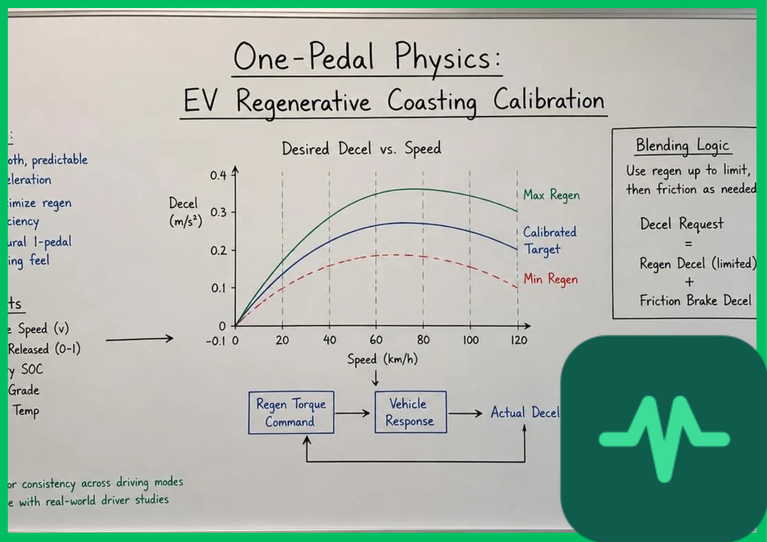
Deceleration Mapping and Accelerator Pedal Travel Mechanics
The user interface of a one-pedal driving system relies on a continuous calibration curve linking the physical displacement of the accelerator pedal to the commanded torque vector of the permanent-magnet synchronous motor (PMSM). In traditional dual-pedal configurations, lifting the foot off the accelerator transitions the powertrain into a coasting state with minimal parasitic drag. In contrast, one-pedal calibration divides the total pedal travel range into distinct operational zones managed by the vehicle control unit (VCU):
- Positive Acceleration Zone: Ranging from 30% to 100% pedal depression, this region commands positive quadrature-axis current (
 ), delivering proportional propulsion torque.
- Zero-Torque Neutral Band: A narrow transition threshold (typically between 20% and 30% pedal travel) creates a deadband or neutral coasting zone, preventing abrupt torque reversals during slight foot micro-adjustments.
- Regenerative Deceleration Zone: Ranging from 0% to 20% pedal depression, releasing the accelerator commands increasing negative quadrature-axis current (
 ), generating controlled electromagnetic braking torque that scales linearly with pedal displacement.
Calibrating this pedal travel gradient requires balancing vehicle deceleration rates against human factor ergonomics. Calibrations typically yield a maximum deceleration rate of  to
 at full pedal release, matching the natural engine braking deceleration profile of traditional internal combustion vehicles operating in lower transmission gears.
Motor Braking Torque Modulation and Inverter Phase Control
Executing precise regenerative coasting deceleration demands real-time modulation of the motor inverter switching states via field-oriented control (FOC). When the driver lifts off the accelerator pedal, the vehicle control unit computes the required braking torque based on vehicle velocity, mass, and current battery state of charge (SoC).
The inverter alters the phase angle of the stator magnetic field relative to the rotor permanent magnets, shifting the torque angle into negative quadrants. This electromagnetic transition forces the permanent-magnet synchronous motor into generator mode, where the rotating rotor induces multi-phase alternating current (AC) voltages across the stator windings. The wide-bandgap silicon carbide ( ) semiconductor switches within the inverter rectify this generated AC power into high-voltage direct current (DC), feeding electrical energy through the DC-link capacitor bank directly into the lithium-ion battery pack.
Torque modulation algorithms must operate at high switching frequencies ( to
 ) to eliminate torque ripple and driveline lash oscillations. Suppressing driveline vibration preserves mechanical gear durability and ensures smooth deceleration transitions across diverse road surface friction coefficients (
 ).
Kinetic Energy Recapture Efficiency and Battery Acceptance Limits
Quantifying the operational effectiveness of regenerative coasting requires evaluating round-trip energy recapture efficiency ( ), which accounts for electromechanical conversion losses across transmission gearing, motor winding resistance, inverter rectification, and battery internal resistance (
 ). The total recoverable kinetic energy (
 ) during a deceleration event from initial velocity
 to final velocity
 for a vehicle of mass
 is expressed as:


Modern electric vehicles equipped with calibrated one-pedal driving systems achieve aggregate round-trip recovery efficiencies between 60% and 75%. However, high-rate energy recapture is strictly governed by battery management system (BMS) charge acceptance limits. Pumping high electrical currents into a lithium-ion battery pack when the state of charge exceeds 90% or when internal cell temperatures drop below  (
 ) induces severe lithium plating on the graphite anode surface.
To prevent destructive lithium dendrite formation and overvoltage conditions, dynamic calibration algorithms automatically scale down maximum regenerative braking torque when battery cells approach upper voltage thresholds or low-temperature operational boundaries.
Technical Data Specifications of Regenerative Braking Parameters
| Calibration & Performance Parameter | Engineering Specification Range |
|---|---|
| Maximum Regenerative Deceleration Rate |  to  pure electromagnetic braking |
| Pedal Release Transition Deadband | 20% to 30% accelerator pedal travel range |
| Inverter PWM Rectification Frequency |  to  switching rate |
| Round-Trip Energy Recapture Efficiency | 60% to 75% mechanical-to-electrical recovery |
| Battery State of Charge (SoC) Limit | Maximum regeneration restricted above 90% SoC |
| Minimum Operating Temperature Threshold |  to  (  to  ) |
| Urban Driving Range Extension Yield | 10% to 20% increased operational distance |
Kinetic Friction Blending and Hydraulic Brake Coordination
Pure electromagnetic regenerative braking cannot maintain deceleration forces as the vehicle approaches a complete standstill. Because permanent-magnet motor back-electromotive force (back-EMF) diminishes as rotor angular velocity approaches zero, electromagnetic braking torque drops off rapidly below vehicle speeds of  to
 (
 to
 ).
To ensure consistent deceleration down to a complete zero-velocity hold without vehicle creep, electronic stability control (ESC) systems execute kinetic friction blending. Hydraulic brake control units coordinate seamlessly with the motor inverter, applying modulated hydraulic pressure to friction brake calipers on the disc rotors precisely as electromagnetic braking torque decays.
This hydraulic blending algorithm operates transparently, maintaining a seamless deceleration profile that eliminates the transition shock or jerk associated with stopping. Furthermore, blending regenerative braking with hydraulic friction reduces physical brake pad and rotor wear by up to 70%, extending brake service intervals across urban delivery and passenger vehicle fleets.
The Final Take
Calibrating one-pedal driving and regenerative coasting profiles bridges human-machine interface design with advanced electric vehicle powertrain physics. Citing automotive engineering literature and International Energy Agency transport efficiency analyses, optimizing pedal torque mapping and kinetic friction blending maximizes urban energy recapture efficiency while preserving driveline stability. By converting inertial momentum back into electrical energy with high precision, electric vehicle regenerative calibration establishes an indispensable technical foundation for sustainable zero-emission transport.


Comments (0)
Login to leave a comment.
No comments yet. Be the first to share your thoughts!