 to
 (
 ), depending heavily on the control strategy used to translate human pedaling input into electrical motor output. Traditional entry-level e-bikes rely on rotational cadence sensors that measure pedal velocity without quantifying rider force, while advanced performance architectures deploy precision torque sensors featuring strain gauge transducers. Understanding the electromechanical performance coefficients and thermodynamic realities of these sensing typologies is essential for optimizing battery range, motor response latency, and drivetrain efficiency.
Cadence Sensor Architecture and Rotational Velocity Detection
Cadence-based pedal-assist systems operate by monitoring the rotational velocity of the crankset rather than the mechanical force exerted on the pedals. A typical cadence sensor assembly consists of a magnetic ring mounted around the bottom bracket axle coupled with a stationary Hall-effect sensor or magnetic pickup coil. As the rider rotates the cranks, passing magnets induce discrete electrical pulses that the motor controller registers as revolutions per minute (RPM).
Once the controller detects crank rotation exceeding a calibrated threshold (typically within one-half to one full rotation), it activates the electric motor at a pre-selected assistance level. Power delivery remains constant relative to the chosen assist tier, regardless of whether the rider applies heavy leg pressure or merely spins the cranks passively. This binary on-off control logic introduces operational inefficiencies:
- Response Latency: The inherent delay between initial crank movement and motor activation creates a noticeable surge or lag during acceleration from a complete stop.
- Ghost Pedaling Phenomenon: Because the motor supplies fixed electrical power based solely on rotation, riders can experience "ghost pedaling," where the drivetrain rotates without meaningful human torque contribution, depleting battery reserves prematurely.
Torque Sensor Transducers and Proportional Force Mechanics
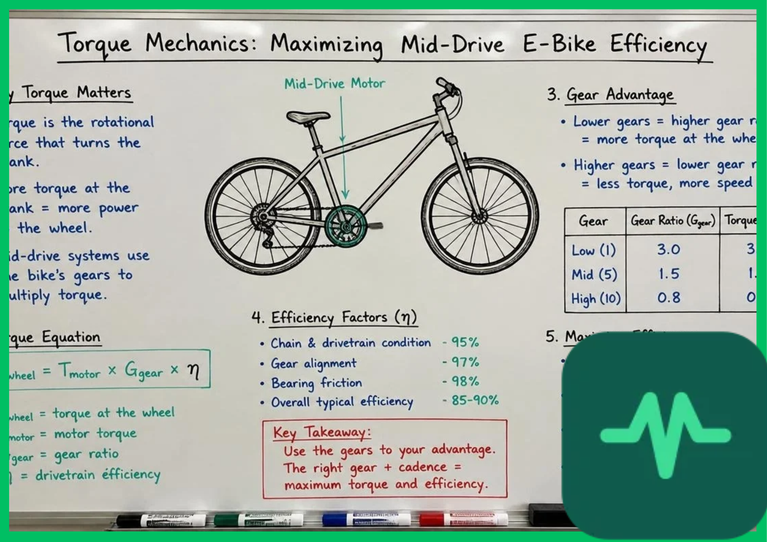
In contrast to rotational velocity detection, torque-sensing architectures measure the precise mechanical force applied by the rider to the drivetrain in real time. These systems integrate piezoelectric or strain gauge transducers directly into the bottom bracket spindle, chainring spider, or rear dropout. When the rider pushes downward on the pedals, microscopic mechanical deflection alters the electrical resistance of the strain gauge bridge, generating an analog voltage signal proportional to the applied torque ( ).
Keren Electric Technologies (Zhejiang) Co., Ltd-Electric vehicle
The motor controller processes this instantaneous torque signal through proportional amplification algorithms, commanding the electric motor to deliver supplementary power matching the rider's immediate effort. The mathematical relationship governing motor power output ( ) in a torque-sensing configuration is expressed as:


where  represents the user-selected assistance multiplier,
 is the measured pedaling torque, and
 denotes the angular velocity of the crankset. This proportional response eliminates operational lag, reducing response latency to less than
 to
 and matching human biomechanical output seamlessly.
Drivetrain Energy Efficiency and Battery Range Optimization
Evaluating the energetic efficiency of e-bike assist mechanisms requires analyzing battery state-of-charge depletion rates and controller electrical efficiency losses. Cadence sensors often suffer from elevated energy consumption because they maintain high motor output during low-effort spinning, converting electrical energy into thermal dissipation within the stator windings when actual mechanical work is minimal.
Torque sensors optimize battery management by modulating electrical current delivery exclusively when mechanical work is registered. By supplying power strictly in proportion to human input, torque-controlled powertrains reduce unnecessary battery drain during urban stop-and-go riding or technical terrain traversal. Field testing and academic electric mobility data confirm that torque-sensing systems extend single-charge battery range by 15% to 30% compared to unmanaged cadence systems operating under identical topographic and payload conditions.
Technical Data Specifications of E-Bike Assist Parameters
| Electromechanical Parameter | Cadence Sensor Architecture | Torque Sensor Architecture |
|---|---|---|
| Input Measurement Variable | Crank rotational velocity ( ) | Applied mechanical force ( ) |
| System Response Latency |  to  (1/2 to 1 full rotation) |  to  (instantaneous strain detection) |
| Power Delivery Logic | Binary / Fixed tier output per assist level | Proportional scaling matching rider torque |
| Battery Range Efficiency Impact | Baseline reference (higher idle draw) | 15% to 30% extended range via proportional draw |
| Sensor Transducer Technology | Hall-effect magnetic ring and pickup | Strain gauge bridges / piezoelectric elements |
| Dynamic Terrain Adaptation | Low (requires manual mode adjustment) | High (adapts instantly to gradient resistance) |
| System Hardware Cost Tier | Economical entry-level integration | Premium precision engineering cost |
Closed-Loop Control Systems and Hybrid Integration
Modern high-performance e-bike engineering increasingly transcends the binary divide between pure cadence and pure torque sensing by integrating dual-input closed-loop control systems. These advanced microprocessors process simultaneous data streams from both torque transducers and high-resolution cadence encoders.
By combining force magnitude with rotational speed, the controller computes real-time human power output in Watts ( ). This holistic metric allows sophisticated firmware algorithms to adjust motor assistance curves dynamically based on slope gradients, transmission gear ratios, and thermal limits within the brushless direct current (BLDC) motor windings. When climbing steep inclines where cadence drops but torque spikes, the hybrid controller ramps up motor torque smoothly without stalling or overheating the inverter electronics.
The Final Take
Mastering e-bike pedal assist efficiency mechanics in torque and cadence highlights the critical role of precision sensing in electric mobility optimization. Citing International Energy Agency transport assessments and academic engineering research, torque-sensing architectures deliver superior energy efficiency, reduced response latency, and extended battery range through proportional power delivery. By replacing rigid rotational triggers with strain-gauge-based force measurements, advanced e-bike powertrains achieve optimal electromechanical harmony between human biomechanics and electric propulsion.
Comments (0)
Login to leave a comment.
No comments yet. Be the first to share your thoughts!