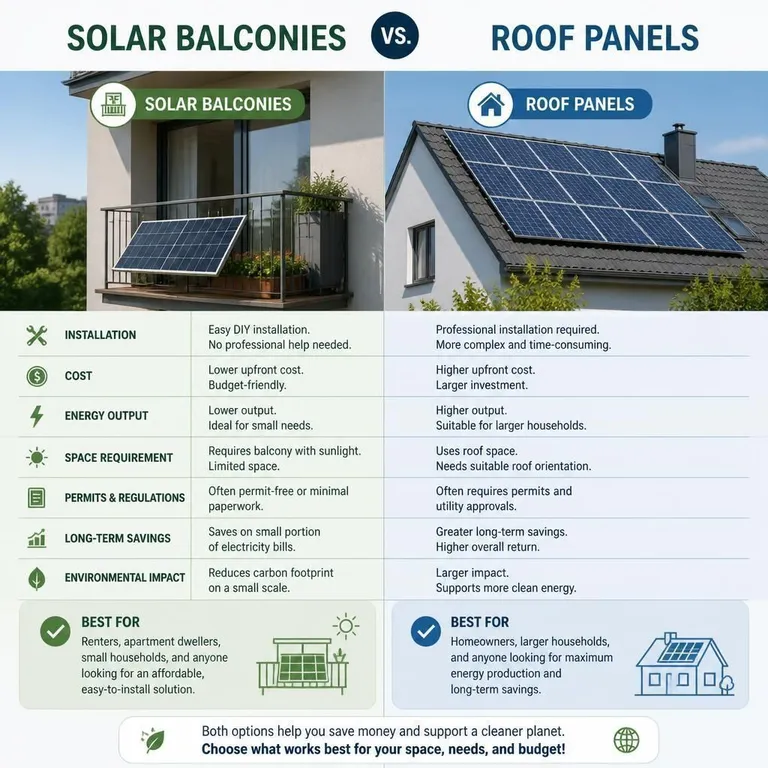
That is changing fast now. New solar balconies are popping up in cities everywhere. They let renters make their own power. You do not need to own a roof. You just need a balcony or a terrace.
These small systems are easy to set up. You do not need permits. You do not need to drill holes. You do not need to call a contractor. Most people can do it alone in one afternoon.
So how do these small kits compare to normal roof panels? Which one should you pick? It depends on where you live and what you need. Let's break it all down, step by step.
What Is a Solar Balcony?
A solar balcony kit is simple. It usually has one or two solar panels. You clip them onto your balcony rail. Some people hang them on a wall instead. Others lean them against a window.
Each kit comes with a small inverter. This part is very important. The inverter turns sun power into power your home can use. Without it, your home could not use the energy at all.
Here is the best part. You do not need an electrician. You just plug the cable into a wall outlet. That's it. No special tools. No wiring in the walls.
Once the sun hits the panels, power starts to flow into your home right away. Your fridge, TV, and Wi-Fi router use it first. This means your power meter slows down. Your bill goes down too, little by little, day by day.
Most kits are also light and small. You can carry one by yourself. This makes them a great fit for small balconies or narrow terraces.
Power Output: Roof Panels Win
Roof panels make a lot more power. This is not close. A full roof system can have 10 to 30 panels. It can produce 4,000 to 10,000 watts. That is enough to run a whole house. Lights, TV, washer, AC, all of it.
Some homes even make extra power. They sell it back to the power company. Over time, this can save a lot of money.
Balcony kits are much smaller. Most are capped at 400 to 800 watts. Why so small? Safety. This limit keeps them safe for normal home outlets. A bigger system could overload the wiring.
But do not count balcony kits out. A small kit can still help a lot. It can cover your home's "background" power use. Think of things like your router, fridge, or phone chargers. These run all day, even when no one is home. Over a month, that adds up.
In sunny areas, a balcony kit can cut daytime power costs by 20% to 35%. That is a real number, not a small one. Results depend on a few things. Sun, shade, and which way your balcony faces all matter. A sunny south-facing balcony will do the best. A shaded, north-facing one will do much less.
So think about your own balcony first. Does it get sun most of the day? Or is it shaded by trees or nearby buildings? This answer will shape how much you save.
Easy to Install, Easy to Move
This is where balcony solar really shines. Roof panels need a lot of work. You need a contractor. You need permits. You need to drill into your roof. Someone has to check the wiring too. This can take weeks, sometimes months.
Balcony kits skip all that. You can set one up in under 40 minutes. You just need basic tools, like a wrench or a screwdriver. Nothing gets drilled or changed. Nothing gets torn apart. That makes it perfect for renters who cannot change their unit.
Moving to a new place next year? No problem at all. Just unplug it. Unclip the panels from the rail. Pack them with your boxes like any other item. Your solar kit moves with you, from apartment to apartment.
This is a big shift in how we think about solar. Roof panels stay with the house forever. Balcony panels belong to you. They travel wherever you go.
Landlords like this too. There is no roof work. No risk to the building. No holes to patch later. So more landlords now allow these kits in their lease rules. Some even encourage tenants to use them.
Cost: Small Kit, Small Price
Roof solar costs a lot upfront. It can cost tens of thousands of dollars. That is a big number for most families. But it pays off over time. Many systems pay for themselves in 7 to 12 years. After that, you get free power for years, maybe even decades.
Balcony kits cost much less. Many cost just a few hundred dollars. Some cost even less. You save less money overall, since they make less power. But you also spend far less to start.
For renters, this is a big deal. You may never own a roof. So roof solar may never be an option for you. Even small savings matter when you have no other way to go solar.
Balcony kits are also easier to maintain. You can clean and check them yourself. It only takes a few minutes. Roof systems often need a pro for repairs. Storm damage or a broken inverter can cost real money to fix.
Over time, this means lower stress for balcony owners. There is less that can go wrong. And what does go wrong is usually easy to fix.
Rules and Safety
Before you buy, check your local rules. This step matters more than people think. Roof solar needs permits almost everywhere. That part is well known and easy to plan for.
Balcony solar is newer, though. Rules are still catching up in many places. Some cities have clear laws. Others have none at all yet.
Some countries, like ones in Europe, already allow small balcony kits with few rules. You can often set one up with no license needed. Other places are still working this out. Laws may change in the next few years as more people buy these kits.
So always check with your city first. Then check with your landlord too, even if the law allows it. A quick message can save you trouble later.
Safety matters just as much as rules. Good balcony kits shut off power during outages. This is called auto shutoff. It protects repair workers on the grid, since it stops your panels from sending power out during a blackout.
Always pick a kit with proper safety certification. Look for a real safety label, not just a low price. Cheap, uncertified kits can be a fire risk. It is always worth paying a little more for a trusted brand.
Good for the Planet Too
Both options help the planet. Both make clean power from the sun. Both cut down on fossil fuels. So no matter which one you pick, you are doing something good.
Roof panels have a bigger impact per home. This makes sense, since they make more power. Over 20 or 30 years, one roof system can cut a huge amount of carbon.
Balcony kits have a smaller impact per home. But there is a catch. Millions of people live in apartments, not houses. So even a small kit, used by millions of renters, adds up fast. Small steps, done by many people, can equal big change.
This is part of why cities are excited about balcony solar. It opens the door to clean energy for people who were left out before. Renters make up a huge share of the population in most big cities. Giving them a way to go solar matters a lot for the planet as a whole.
Final Answer: It Depends on You
There is no single "best" choice here. It depends on what you have and where you live.
If you own a home, roof panels are still the top pick. They make more power. They last a long time. They also add value to your home if you ever sell it.
If you rent, a balcony kit is a great option. It is cheap. It is fast. It is easy to move. It may not power your whole home, but it still helps every single day.
Think about your own life for a moment. Do you own your roof, or do you rent your space? Do you plan to stay for years, or move again soon? Your answer will point you toward the right choice.
Either way, the bigger picture is good news. Solar power is no longer just for homeowners with big roofs and big budgets. Now, almost anyone can use the sun. Whether you own a house or rent a small apartment, there is finally a real way to start. All it takes is one small step onto your balcony.

Comments (0)
Login to leave a comment.
No comments yet. Be the first to share your thoughts!