Then digital meters came along. They let the power company read your usage from far away. That helped the utility. It did not help you much at all.
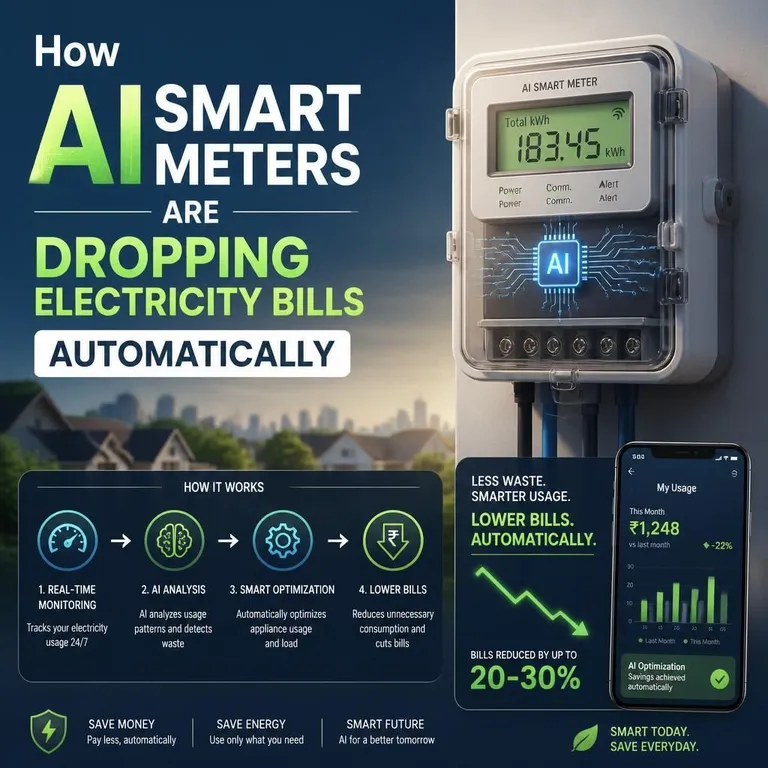
Now, a new kind of meter is changing the game. AI smart meters are taking over. They do not just track power. They actively manage it. They work in the background, all day, to lower your bill without you lifting a finger.
In this guide, we will look at how AI smart meters work. We will also look at how they save money, spot broken appliances, and help the whole power grid run better. By the end, you will understand why AI smart meters are becoming such a big deal in modern homes.
Why Old Meters Were Not Enough
Power pricing used to be simple. You paid one flat rate, no matter the time of day. That made planning easy, but it was not efficient for the grid.
Today, many utility companies use time-of-use pricing instead. This means power costs more during busy evening hours. It costs less late at night. So the price of running your dryer at 6 PM can be much higher than running it at 2 AM.
This creates a real problem. No family wants to sit around checking hourly power rates. No one wants to plan every load of laundry around a pricing chart. It is simply too much manual work for a normal household.
This is exactly the gap that AI smart meters fill. Instead of asking you to track prices, AI smart meters do it for you. They watch pricing changes. They watch your habits. Then they act, automatically, without you needing to think about it.
How AI Smart Meters Learn Your Home
So how do AI smart meters actually figure out what is using power in your house? The answer lies in a clever method called Non-Intrusive Load Monitoring, or NILM.
In the past, saving energy meant buying separate sensors for every device. You would need one for your fridge. Another for your water heater. Another for your AC unit. This was expensive and annoying to set up.
AI smart meters skip all of that. They do not need extra sensors on every appliance. Instead, they watch the electrical signal coming into your whole home. Every appliance creates its own tiny electrical "fingerprint" when it turns on. A microwave looks different from a water heater. A refrigerator looks different from a hair dryer.
AI smart meters sample this electrical signal thousands of times per second. Over just a few days, the system learns to recognize each device in your home. It builds a full map of your energy use, all without a single extra sensor.
This is a big shift in how energy monitoring works. AI smart meters make it possible to understand your whole home's energy picture using just one device: the meter itself.
Catching Problems Before They Get Expensive
Here is a surprising bonus feature. AI smart meters do not just track energy. They can also catch appliances that are starting to fail.
Think about your refrigerator. As its compressor wears out, it often needs more power to keep food cold. A normal person would never notice this slow change. But AI smart meters notice it right away.
If a fridge starts drawing extra power, the system flags it. It can send you a warning before the appliance fully breaks down. This kind of early alert can save you from a much bigger repair bill later. So beyond saving money on electricity, AI smart meters can also help you avoid surprise appliance failures.
Automated Load Shifting: The Real Money Saver
Now let's talk about the biggest reason people love AI smart meters: automated load shifting. This is where the real savings happen.
AI smart meters stay connected to your local utility's pricing data in real time. They always know when power is cheap and when it is expensive. Then, they use this knowledge to control your biggest energy users.
Picture this scenario. You plug in your electric vehicle at 6 PM. A normal charger would start pulling power right away, during the most expensive hour of the day. An AI smart meter works differently. It pauses the charge. It checks the current grid pricing. Then it waits until around 2 AM, when rates drop to their lowest point, before starting the charge.
This single change can lead to big savings over time. Multiply that across a heat pump, a home battery, and other big appliances, and the numbers add up fast.
If your home has solar panels, AI smart meters take on an even bigger role. They act like a smart traffic controller for your power. Should the extra solar energy go into a home battery? Should it be used to pre-cool your house before the heat of the day? Or should it be sold back to the grid for a profit? AI smart meters make this call automatically, based on real-time pricing and weather patterns.
Real Savings, Real Numbers
So how much can AI smart meters actually save homeowners? On average, households using AI smart meters see savings of 15% to 25% on peak electricity costs. That is a meaningful drop for most family budgets.
These savings come from a few key places. Shifting big loads to cheaper hours is one major factor. Catching failing appliances early is another. And simply avoiding wasted energy from idle devices adds up too.
Over a full year, these small daily wins from AI smart meters can turn into hundreds of dollars saved. For families with an EV or solar panels, the savings can be even larger.
How AI Smart Meters Help the Whole Power Grid
AI smart meters are not just good for individual homes. They also help the larger power grid run more smoothly.
Here is why this matters. When too many homes use power at the exact same time, usually early evening, the grid gets stressed. Utility companies often need to fire up extra backup power plants to handle this rush. These backup plants are often old, dirty, and expensive to run.
Now imagine thousands of homes using AI smart meters at once. Each meter is shifting small loads to quieter hours. Multiply that across a whole city, and the evening demand spike starts to flatten out. This means utilities need fewer emergency backup plants. That means cleaner air and a more stable grid for everyone, not just for people with AI smart meters installed.
This is one reason many energy experts see AI smart meters as more than a personal money-saving tool. They see them as a piece of public infrastructure that benefits entire communities.
Setting Up AI Smart Meters in Your Home
Getting started with AI smart meters is usually simpler than people expect. Most systems are designed to install at your home's main electrical panel. From there, they can see your whole home's power use at once.
Many AI smart meters also connect with common smart home gear. This includes smart plugs, EV chargers, and solar inverters. Once connected, the AI can control these devices directly, without you needing to adjust any settings by hand.
Setup usually takes just a few hours with a licensed electrician. After that, the learning process begins. Within about a week, most AI smart meters have a fairly accurate picture of your home's appliances and habits.
What to Expect as AI Smart Meters Improve
Like most smart technology, AI smart meters are only getting better with time. Early versions were mostly focused on basic tracking. Newer models focus heavily on prediction and automation.
Future AI smart meters may connect even more closely with weather forecasts. This would let them plan ahead for hot or cold days, adjusting your home's energy use before a heat wave or cold snap even hits. Some future systems may also work directly with neighborhood microgrids, helping balance power between multiple homes at once.
As more utility companies roll out time-of-use pricing, the value of AI smart meters will likely keep growing. The bigger the price gap between peak and off-peak hours, the more money these systems can save.
Common Questions About AI Smart Meters
Before we wrap up, let's cover a few quick questions people often ask about AI smart meters.
Do AI smart meters cost a lot to install? Prices vary depending on your home and utility provider. Some utilities offer AI smart meters as part of an upgrade program at low or no cost. Others require homeowners to purchase and install the hardware themselves. Either way, most families recover the cost through savings within a couple of years.
Do AI smart meters work without solar panels or an EV? Yes. AI smart meters can still help without solar or an EV. They still track your daily habits. They still catch failing appliances early. They still shift smaller loads, like your dishwasher or dryer, to cheaper hours. The savings may be smaller than a home with solar and an EV, but they are still real.
Is my data safe with AI smart meters? Reputable providers use encrypted connections to protect your data. It is still worth checking a provider's privacy policy before installing any AI smart meters. Ask how your usage data is stored and whether it is shared with third parties.
Can AI smart meters work with an older home? In most cases, yes. AI smart meters are usually installed at the main electrical panel, not on individual appliances. This makes them a good fit for older homes, as long as the panel itself is in safe working condition.
The Bigger Picture for Home Energy
Stepping back, AI smart meters represent a much larger shift happening across the energy industry. Homes are no longer just consumers of power. They are becoming active participants in how the grid runs.
This shift matters for more than just individual savings. As more renewable energy sources like solar and wind join the grid, power supply becomes less predictable. AI smart meters help smooth out this unpredictability at the household level, one home at a time.
Utility companies are taking notice too. Many are now offering incentives for customers who install AI smart meters, since it helps reduce strain on their infrastructure. This creates a win-win setup. Homeowners save money. Utilities save on emergency infrastructure costs. The whole system becomes more efficient as a result.
Final Thoughts
The shift from passive meters to AI smart meters marks a real turning point for home energy management. What used to be a simple box on the side of your house is now an active, smart tool working on your behalf around the clock.
AI smart meters handle the hard parts for you. They track pricing. They learn your habits. They shift big loads to cheaper hours automatically. They even catch failing appliances before they become expensive problems.
As energy prices keep shifting throughout the day, having a system that reacts in real time only makes more sense. AI smart meters take the guesswork out of saving money on power, all without asking homeowners to change their daily routines.
As this technology becomes more affordable, expect AI smart meters to become a standard feature in homes everywhere, not just a luxury upgrade. For homeowners looking to cut costs and reduce stress on the power grid, AI smart meters offer a simple, powerful solution that works quietly in the background, day and night.
Comments (0)
Login to leave a comment.
No comments yet. Be the first to share your thoughts!