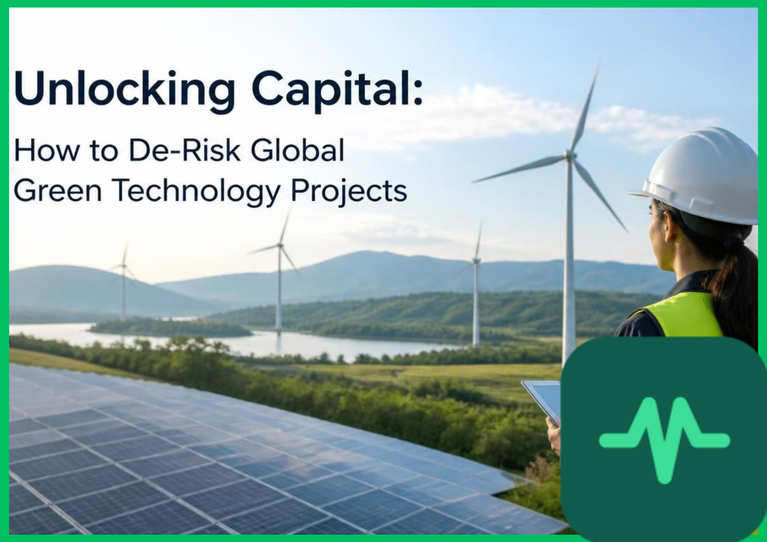
The engineering blueprints are ready. The physical land is mapped out. The technology is proven and prepared to change the world.
Yet, nothing happens.
The project stalls. Financing falls through, and construction equipment stays parked in a lot miles away.
Why? Because investors look at the project and see too much risk.
According to financial reports from the International Energy Agency (IEA), sustainable transition assessments from the United Nations Environment Programme (UNEP), and academic research on green finance, capital is waiting on the sidelines. Trillions of dollars are available globally, but they remain locked away by perceived financial, regulatory, and operational risks.
De-risking green technology projects is the single most critical challenge standing between our current energy system and a sustainable global economy.
Here is how modern financial frameworks, blended finance models, and policy structures unlock capital to build tomorrow's clean energy infrastructure.
The Risk Barrier in Sustainable Infrastructure
To understand why clean energy projects struggle to secure funding, you have to look through the eyes of an institutional investor.
Pension funds, sovereign wealth managers, and major commercial banks manage trillions of dollars on behalf of everyday people. Their primary responsibility is safety and predictable returns.
When investors evaluate a traditional fossil fuel project, the risks are well-understood. The regulatory paths are paved, the supply chains are entrenched, and historical cash flows provide a comfortable baseline.
Green technology projects, by contrast, often feel unpredictable.
Many clean energy initiatives involve high upfront capital expenditures paired with long payback periods.
In developing markets or emerging technology sectors, investors worry about regulatory shifts, currency fluctuations, grid connection delays, and unproven long-term operational costs.
When risks look high and uncertain, investors demand exorbitant interest rates or refuse to fund the project entirely. High borrowing costs choke green tech before it ever leaves the drawing board.
The Power of Blended Finance
Lowering the cost of capital requires innovative financial tools designed specifically to absorb and share early-stage risk.
The most effective tool in modern green finance is blended finance.
Blended finance brings together public funds from international development banks, philanthropic organizations, and private sector capital into a single investment vehicle.
Public and philanthropic funders step in to take the riskiest tranche of capital—often called first-loss capital.
If unexpected roadblocks delay construction or initial revenues fall short, the public or philanthropic buffer absorbs the financial blow.
This protective cushion shields commercial investors from catastrophic losses.
With their primary risk mitigated, private banks and institutional funds feel confident stepping in with massive pools of commercial capital at standard, affordable interest rates.
Blended finance acts as a bridge, transforming risky green projects into bankable commercial investments.
Streamlining Regulatory and Institutional Certainty
Financial risk is rarely purely economic; it is deeply tied to institutional stability and regulatory clarity.
Academic research on sustainable investment proves that transparent, predictable government policies do more to attract capital than direct subsidies ever could.
When international bodies and national governments establish clear, long-term legal frameworks for renewable energy, grid access, and carbon pricing, they eliminate regulatory ambiguity.
Investors need to know that contracts signed today will be honored ten or twenty years down the road.
Streamlining environmental review processes, standardizing grid connection permits, and establishing reliable payment enforcement mechanisms drastically lower project risk profiles.
When regulatory friction disappears, financing costs drop immediately, and capital flows freely into clean infrastructure.
Mitigating Technological and Operational Risks
As green technologies evolve into newer sectors—such as advanced geothermal energy, long-duration energy storage, and industrial green hydrogen—investors face technical uncertainties.
To de-risk these emerging innovations, public-private research partnerships and independent engineering validations play a vital role.
When academic institutions and recognized technology standards bodies thoroughly test new hardware and publish performance data, they replace guesswork with empirical proof.
Furthermore, performance guarantees and warranty backstops provided by equipment manufacturers give lenders the operational security they require.
When a multi-million-dollar green asset comes with reliable performance insurance, lenders view it as a stable, predictable income generator rather than a speculative gamble.
Opening the Floodgates to a Sustainable Future
Unlocking global clean energy investment is not just about finding more money. It is about restructuring how we manage risk.
By deploying blended finance models, securing predictable regulatory frameworks, and validating new clean technologies, we dismantle the barriers keeping capital trapped on the sidelines.
When green projects become low-risk, high-confidence investments, global wealth pours into sustainable infrastructure.
We have the technology, the capital, and the urgency. By de-risking the journey from blueprint to reality, we open the floodgates to a clean, resilient global future.


Comments (0)
Login to leave a comment.
No comments yet. Be the first to share your thoughts!