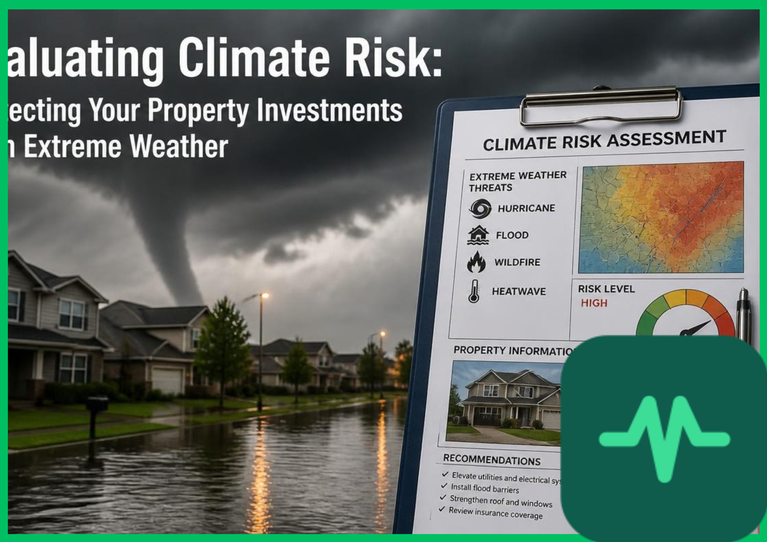
For generations, real estate investing followed a simple rule: location, location, location. You checked local schools, neighborhood safety, and proximity to city centers.
Today, a new and urgent factor demands your attention.
Physical climate risks are reshaping property values across the globe. Rising sea levels, severe droughts, extreme heatwaves, and intensifying storms are threatening homes and commercial buildings alike.
If you own real estate, ignoring climate exposure is a costly mistake.
Evaluating physical climate risk protects your property investments from sudden depreciation, high insurance costs, and stranded asset losses.
Here is how to assess environmental vulnerabilities before making your next major real estate move.
The Changing Reality of Property Valuation
Weather patterns are shifting faster than municipal zoning laws.
Properties that sat comfortably above historical flood lines are now facing repeated inundation. Homes in dry, forested regions confront increasingly violent wildfire seasons. Urban properties suffer under severe heat islands without adequate cooling infrastructure.
Traditional property valuation models rely heavily on historical data. They look at what happened over the last thirty years to predict the next thirty years.
That backward-looking approach is breaking down.
When historical weather data no longer predicts future risks, property markets begin to reprice rapidly. A home vulnerable to climate disasters can lose market value overnight, leaving owners trapped with a depreciating asset.
Understanding Physical Climate Risk
Physical climate risk falls into two main categories: acute risks and chronic risks.
Acute risks are sudden, violent events. These include flash floods, hurricanes, severe windstorms, and wildfires. They cause immediate physical damage to roofs, foundations, and electrical systems.
Chronic risks are slow-moving, long-term shifts. These include rising average temperatures, gradual sea-level rise, chronic water scarcity, and shifting soil stability caused by drought.
Both types of risk erode property value. A coastal home might not flood today, but rising insurance premiums driven by long-term sea-level rise can make owning the property financially unsustainable.
Mitigating Stranded Asset Losses
In finance, a stranded asset is an investment that loses economic value long before the end of its useful economic life.
Real estate can become stranded, too.
If a commercial building or residential property becomes uninsurable due to extreme weather exposure, buyers disappear. Banks hesitate to issue mortgages for high-risk zones.
Mitigating stranded asset losses requires rigorous environmental due diligence before you buy or develop property.
Look past the fresh paint and modern kitchen renovations. Investigate local watershed maps, wildfire risk zones, drainage infrastructure, and local municipal adaptation plans. Ensure the buildings you invest in are engineered to withstand local environmental extremes.
Building Resilient Real Estate Portfolios
Protecting your real estate investments means investing in resilience.
Upgrade vulnerable structures to withstand local climate pressures. Install impact-resistant roofing, improve property drainage, upgrade insulation for extreme heat retention, and ensure backup power systems are in place.
If you are evaluating new property purchases, look for locations with robust natural defenses, strong civic infrastructure, and forward-thinking municipal planning.
Real estate should be a safe, reliable store of wealth. By evaluating climate risks honestly and investing in resilient properties, you protect your capital and secure your future against an unpredictable world.



Comments (0)
Login to leave a comment.
No comments yet. Be the first to share your thoughts!