
 to
 per rack (
 to
 ), high-density artificial intelligence compute racks frequently reach
 to
 per rack (
 to
 ), and large campus developments routinely demand
 to
 (
 to
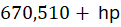 , where
 ). Concentrating multi-hundred-megawatt loads into constrained substations and transmission corridors creates severe grid capacity bottlenecks while pushing air-cooled thermal envelopes past physical limits. Evaluating high-density rack power, liquid cooling thermal rejection, power usage effectiveness, and baseload clean power procurement is essential for analyzing data center grid capacity and thermal physics.
High-Density Rack Power and Grid Capacity Bottlenecks
Expanding AI compute density changes how electrical loads behave on regional transmission and distribution networks. Graphics processing units (GPUs) and specialized tensor accelerators draw large transient currents during model training runs and batch inference bursts, creating rapid ramp rates and high utilization factors that can exceed 70% to 90% of allocated capacity around the clock.
Connecting a  (
 ) facility to a transmission or sub-transmission network requires high-voltage switchgear, step-down power transformers, short-circuit fault current mitigation, and sufficient feeder thermal headroom. In regions where transmission line construction lags behind demand growth or interconnection queues face multi-year backlogs, grid capacity bottlenecks delay site energization or force operators to co-locate behind-the-meter generation, battery storage, or flexible load-curtailment agreements.
Transient power fluctuations also test voltage stability and harmonic distortion limits on medium- and high-voltage buses. Synchronizing multi-stage uninterruptible power supplies (UPS), static transfer switches, and active harmonic filters helps smooth step changes in compute draw while keeping power factor near unity across varying load states.
Liquid Cooling Thermal Rejection and Thermodynamic Limits
Nearly all electrical energy supplied to server processors, memory, power supplies, and interconnects converts into sensible heat inside the facility. For a compute rack dissipating thermal power  across a coolant or air stream with mass flow rate
 and specific heat capacity
 , steady-state heat removal obeys:

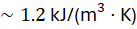
where  is the temperature rise between inlet and outlet streams. Air cooling relies on convective heat transfer across finned heat sinks using forced air velocities; however, air has low volumetric heat capacity (
 at standard conditions) and requires rising fan power as airflow increases, making high-density rack power above
 to
 (
 to
 ) thermally challenging and acoustically or aerodynamically inefficient in standard air aisles.
Liquid cooling thermal rejection addresses this constraint using direct-to-chip cold plates or immersion baths circulating water, propylene/ethylene glycol mixtures, or engineered dielectric fluids. Because liquids exhibit high volumetric heat capacity and superior convective heat transfer coefficients compared to air, cold plates capture heat directly from high-flux processor packages and transfer it to facility coolant distribution units (CDUs) and dry coolers, chillers, or cooling towers. Higher coolant return temperatures ( to
 [
 to
 ] in warm-water direct-to-chip loops) can also expand free-cooling hours and improve heat-rejection efficiency under moderate or warm ambient temperatures (
 to
 [
 to
 ]).
Technical Data Specifications of AI Data Center Power & Thermal Systems
| Facility & Thermal Parameter | Engineering & Operational Specification Standard |
|---|---|
| High-Density AI Rack Power |  to  (  to  ) per rack |
| Campus Electrical Load Scale |  to  (  ) |
Power Usage Effectiveness ( ) | 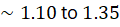 (modern liquid/hybrid vs. legacy air) |
| Direct-to-Chip Coolant Return |  to  (  to  ) warm-water target |
| Ambient Climate Operating Span |  to  (  to  ) heat-rejection envelope |
Water Usage Effectiveness ( ) | Near  (closed-loop/dry) to 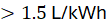 (evaporative) |
| Power Conversion Reference |  ;  |
Power Usage Effectiveness and Water Trade-Offs
Facility electrical overhead is tracked using power usage effectiveness ( ), defined as the ratio of total facility energy entering the data center to energy delivered directly to IT compute equipment:
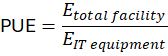
An ideal theoretical lower bound of  means zero cooling, lighting, or power-distribution losses; well-engineered modern hyperscale facilities often target
 values between
 and
 , whereas older air-cooled facilities frequently run higher. However,
 alone does not capture water consumption or grid carbon intensity. Evaporative cooling towers reject heat efficiently at high ambient wet-bulb temperatures, yet consume substantial freshwater—creating water-stress trade-offs in arid regions—whereas closed-loop dry coolers or liquid-to-liquid heat exchangers conserve water at the expense of higher approach temperatures or fan/pump energy during hot afternoons.
Baseload Clean Power Procurement and Grid Reliability
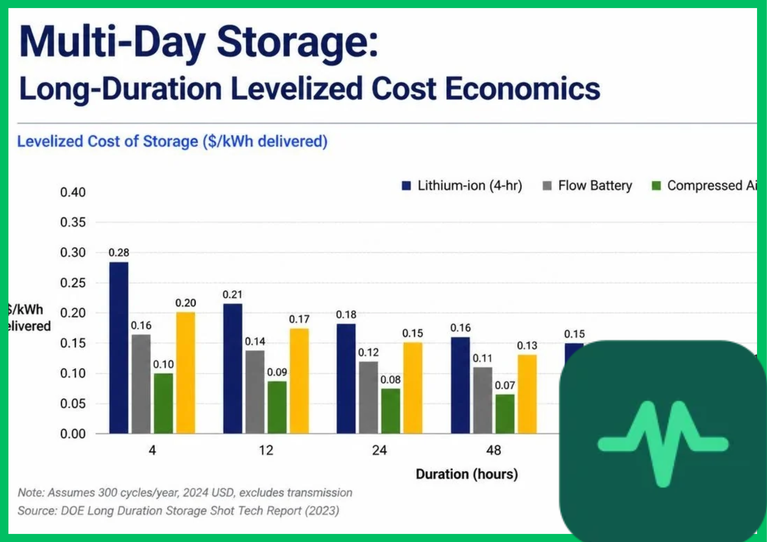
Matching continuous, high-load data center demand with clean electricity requires addressing intermittency across wind and solar generation. Intermittent renewables vary with weather and diurnal cycles, whereas compute clusters run continuously unless workloads are spatially or temporally shifted. Consequently, operators pursue baseload clean power procurement—combining firm low-carbon sources such as nuclear, geothermal, or hydroelectric generation with wind, solar, battery storage, and long-duration energy storage—to align hourly generation profiles with high-capacity-factor loads.
When firm clean generation is scarce locally, adding large unabated loads can extend fossil generation runtimes or delay grid decarbonization unless paired with new clean capacity additions, grid-enhancing technologies, and load-flexibility mechanisms. Coordinating compute scheduling with grid signals and investing in transmission and firm clean power helps prevent grid capacity bottlenecks while supporting reliable digital infrastructure.

Comments (0)
Login to leave a comment.
No comments yet. Be the first to share your thoughts!