Why this comparison matters right now
A useful way to understand any policy is to watch what happens when it changes. Recently, some regions removed major financial support for electric vehicle buyers. Others kept support steady, or even expanded it.
Comparing these outcomes gives us a genuinely clear, real-world look at how much these incentives actually influence buyer behavior.
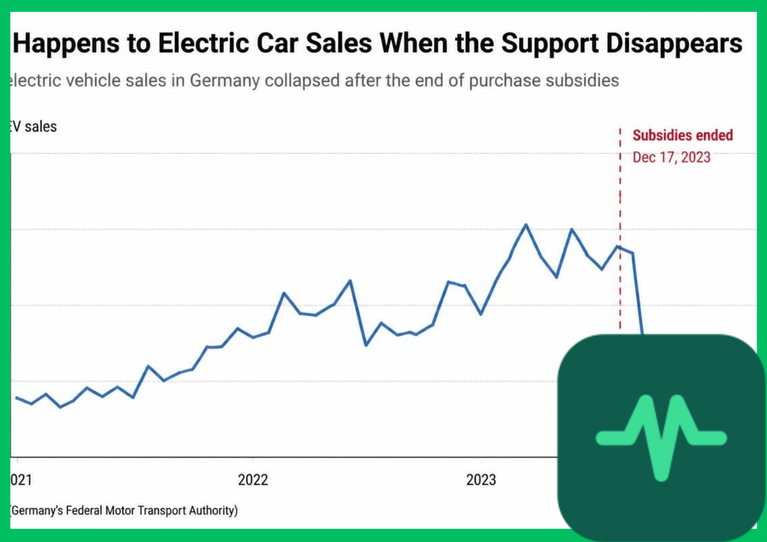
What happened where support was removed
In places where financial incentives for electric vehicles ended, sales fell noticeably in the months that followed. Buyers who might have purchased an electric vehicle held off, switched to a traditional vehicle instead, or simply delayed their purchase.
This wasn't a small, subtle shift. In some cases, sales dropped sharply within just a few months of losing that support.
What happened where support continued
Meanwhile, in regions where support stayed in place, or where electric vehicles had already become naturally competitive on price without needing incentives, growth continued strongly. Some markets saw sales climb by significant percentages over the same period.
This contrast tells an honest, important story about how much government policy still shapes buyer decisions in many parts of the world.
Why this doesn't mean electric vehicles are only popular because of subsidies
It would be easy to conclude that people only buy electric vehicles because of financial incentives. The fuller picture is more nuanced than that.
In markets where electric vehicles have become genuinely price-competitive with traditional vehicles, without needing government support, sales have continued growing strongly regardless of incentive changes. This suggests incentives matter most during an earlier stage, when prices haven't yet reached that competitive point on their own.
The honest role of vehicle affordability
A major factor separating these different markets is simple price competitiveness. Where a wide range of affordable electric vehicle options exists, buyers don't need as much extra financial encouragement to choose one.
Where affordable options remain limited, removing financial support creates a bigger, more immediate gap between what buyers can afford and what's actually available to them.
Why this matters for understanding global EV trends
Reading a single headline about falling electric vehicle sales in one specific region can create a misleading impression about the technology overall. The honest, complete picture requires looking at multiple regions together.
While some markets saw declines tied directly to policy changes, many others continued growing strongly during the very same period, sometimes even accelerating.
What this reveals about policy's actual role
This comparison suggests government policy plays a genuinely significant role in the pace of electric vehicle adoption, particularly in markets where vehicle costs haven't yet reached full competitiveness with traditional options.
This isn't necessarily a criticism of electric vehicles themselves. It reflects how any newer technology often benefits from support during its earlier growth phase, before manufacturing scale and competition bring prices down naturally.
Why manufacturing scale changes this equation over time
As more manufacturers compete and production scales up, electric vehicle prices have been falling in many markets, independent of any government incentive. This growing price competitiveness gradually reduces how much a policy change actually affects buyer decisions.
Markets further along this path tend to be more resilient to policy shifts than markets still relying heavily on incentives to bridge a real price gap.
What buyers in any market should genuinely consider
If you're considering an electric vehicle, it's worth checking your own region's current policy environment and how it might be shifting, rather than assuming incentives will remain exactly as they are indefinitely.
It's also worth comparing the total cost of ownership honestly, not just the sticker price, since ongoing savings on fuel and maintenance can still make a real difference even without upfront financial support.
Why this story will likely keep evolving
Policy environments continue shifting in various regions, sometimes adding support, sometimes removing it. This creates an ongoing, honest experiment showing how sensitive buyer behavior remains to these changes over time.
Watching how different markets respond gives useful, real information about where the electric vehicle transition genuinely needs continued support, and where it's becoming self-sustaining on its own merits.
The bottom line
Removing financial support for electric vehicles has led to real, measurable sales declines in several markets recently, while other regions without the same policy changes kept growing strongly. This honestly shows that incentives still matter in many places, even as the technology itself continues maturing.
Understanding this nuance helps you read global electric vehicle news more accurately, recognizing that a decline in one specific market rarely tells the complete, honest story happening everywhere else at the same time.



Comments (0)
Login to leave a comment.
No comments yet. Be the first to share your thoughts!