Residential micro-wind turbines promise to fill exactly that gap. It is a source of clean power that keeps spinning through the night, through storms, through the exact conditions that leave solar panels dark. On paper, it sounds like the perfect complement.
In practice, home wind turbines have earned a reputation for mixed reviews, wildly variable real-world efficiency, and installation requirements that catch a lot of homeowners off guard. So which is it — a smart, resilient addition to a home energy system, or an expensive mistake dressed up in green marketing? This article breaks down the real-world efficiency, true installed costs, and geographic limitations of small wind systems, so you can tell the difference before you commit.
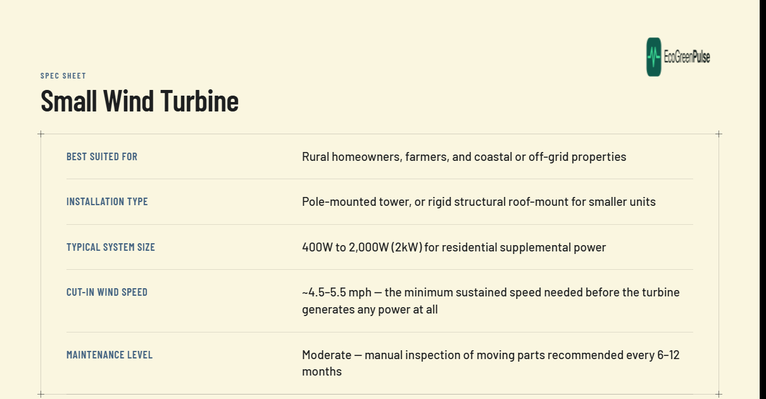
At a Glance: What a Micro-Wind System Actually Looks Like
| Best suited for | Rural homeowners, farmers, and coastal or off-grid properties |
| Installation Type | Pole-mounted tower, or rigid structural roof-mount for smaller units |
| Typical system size | 400W to 2,000W (2kW) for residential supplemental power |
| Cut-in wind speed | ~4.5–5.5 mph (the minimum sustained speed needed before the turbine generates any power at all) |
| Maintenance level | Moderate — manual inspection of moving parts recommended every 6–12 months |
That last row matters more than it might look at first glance, and we'll come back to it. This is because "moderate maintenance" is doing a lot of work in that sentence.
Horizontal vs. Vertical Axis: Two Very Different Machines
Not all small wind turbines work the same way, and the design you choose has a real effect on how well the system performs at your specific property.
Horizontal-Axis Wind Turbines (HAWT) are what most people picture when they hear "wind turbine" — the classic propeller-blade design, spinning on a horizontal shaft, essentially a small version of the giant turbines you see on wind farms. HAWTs are the more efficient design when conditions are right, but that efficiency comes with a catch: the whole turbine needs to face directly into the wind to perform well, which is why most HAWTs include a tail fin that constantly steers the rotor to track shifting wind direction. When the wind is steady and comes from a consistent direction, this works beautifully. When it doesn't, the turbine spends much of its time re-orienting instead of generating power.
Vertical-Axis Wind Turbines (VAWT) look more like a spinning egg-beater or a stack of curved blades wrapped around a vertical shaft. Their key advantage is that they capture wind from any direction simultaneously — no tail fin, no need to track wind direction at all — which also makes them meaningfully better at handling turbulent, swirling airflow rather than smooth, steady wind. The tradeoff is raw output: under ideal, consistent wind conditions, a VAWT typically generates somewhat less energy than a similarly sized HAWT would. In other words, VAWTs sacrifice some peak efficiency in exchange for reliability in messier, real-world wind conditions — which, as the next section explains, describes most residential properties.
The Factor That Decides Everything: Wind Speed and Local Turbulence
Here's the physics that most marketing materials for home wind turbines conveniently leave out: wind power scales with the cube of wind speed. That's not a minor detail — it means a relatively small drop in wind speed causes a dramatically larger drop in electricity output. Cut the wind speed in half, and you don't lose half your power output — you lose roughly seven-eighths of it. This single fact explains almost everything about where micro-wind turbines succeed and where they quietly become expensive lawn ornaments.
Why most neighborhoods are a poor environment for wind turbines. Houses, trees, fences, and other structures don't just block wind — they break smooth, laminar airflow into chaotic, swirling turbulence. A turbine sitting in that turbulent air isn't just getting less wind; it's getting wind that constantly changes speed and direction from one second to the next, which is exactly the condition every turbine design performs worst in. This is why a wind speed reading from a nearby weather station — often measured well above rooftop clutter — can dramatically overstate what a turbine mounted in your actual backyard will experience.
Where micro-wind genuinely works. Large, open rural acreage, open mountain valleys, and coastal properties where wind arrives relatively unobstructed are where these systems perform close to their rated specifications. If your property doesn't look like that — if it's a standard suburban lot with neighboring houses and mature trees nearby — a wind turbine is likely to underperform its advertised numbers substantially, regardless of how good the turbine itself is.
The Financial Reality — and the Maintenance Solar Doesn't Have
Solar panels have no moving parts. Once mounted, they sit still and convert sunlight for decades with minimal intervention beyond the occasional cleaning. Wind turbines are the opposite proposition entirely: they're mechanical systems that spin continuously, which means bearings wear, blades degrade from weather exposure and fatigue, and alternators eventually fail — none of which happens on its own schedule, and all of which requires routine mechanical upkeep to catch before it becomes a costly failure.
On cost, it's worth being precise, because marketing materials for small wind systems often understate this significantly. According to the U.S. Department of Energy's National Renewable Energy Laboratory (NREL), the median installed cost for small residential wind systems is approximately $8,000 per kW as of its most recent Distributed Wind Market Report, with a typical real-world range of roughly $4,000 to $12,000 per kW depending on tower height, site accessibility, and system complexity. A basic 1kW system, once you include a proper tower (height matters enormously for avoiding turbulence) and professional installation, realistically lands well above the bare unit price alone — budgeting $4,000–$8,000 even for a small, well-sited 1kW system is a far more honest starting point than the bargain-bin figures sometimes advertised for the turbine hardware alone.
On return on investment, the honest range most homeowners actually experience is 7 to 20+ years to break even on utility savings, with the low end reserved for genuinely excellent wind sites and the long end far more common in marginal locations. In a low-wind area — which, per the physics above, includes most suburban and urban properties — a 15-to-20-year payback period, or longer, is a realistic expectation, not a worst-case scenario.
The Final Verdict
Residential micro-wind turbines are not a plug-and-play upgrade for the average suburban home, and they're certainly not viable for apartment dwellers or anyone without significant open land. The physics of turbulence and the cube-law relationship between wind speed and power output are unforgiving of imperfect siting, and the real installed costs are considerably higher than casual research often suggests.
But dismissing the technology entirely would be a mistake too. On a spacious, genuinely windy rural or coastal property — particularly one where grid power is unreliable, expensive, or simply unavailable — a well-sited micro-wind turbine, paired with solar as a hybrid system, fills exactly the gap solar can't: real power generation through the night and through the storms that would otherwise leave a solar-only system dark. For the right property, that combination isn't a novelty — it's genuine energy resilience. For everyone else, the money is almost always better spent expanding a solar array or adding battery storage instead.



Comments (0)
Login to leave a comment.
No comments yet. Be the first to share your thoughts!