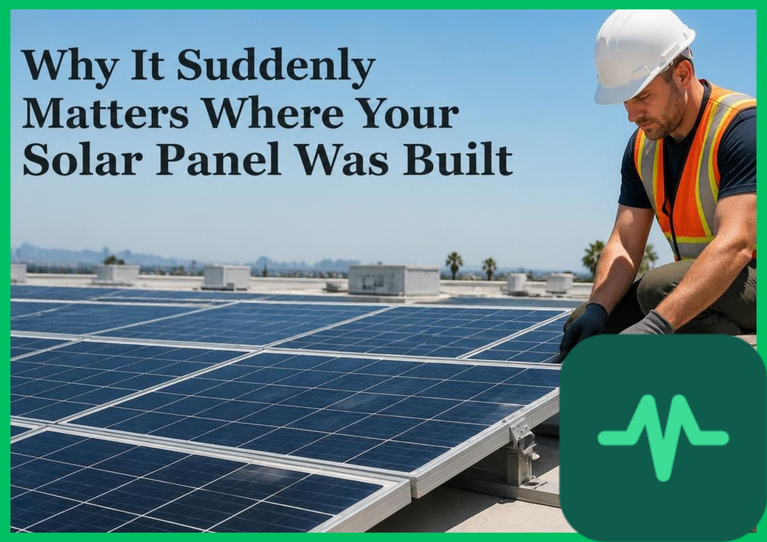
Yet increasingly, where clean energy equipment gets built has become almost as important a question as the technology itself. Here's why.
Why manufacturing location became such a big deal
For years, clean energy manufacturing became heavily concentrated in just a few countries. This happened for understandable reasons, including cost advantages, manufacturing experience, and large-scale investment built up over many years.
This concentration created real efficiency and lower prices. It also created real risk. If most of the world's supply comes from just one or two places, any disruption there ripples out to affect everyone relying on that supply.
Why countries are now investing in diversifying this
Many countries and companies have started investing specifically in building clean energy manufacturing capacity outside these traditionally dominant regions. This isn't about the technology being better elsewhere. It's about reducing dependence on any single source.
Think of it like keeping backup suppliers for something important, rather than relying entirely on just one source that could face unexpected problems down the road.
The honest cost of this diversification
Building new manufacturing capacity elsewhere often costs more, at least initially, than continuing to rely on already-established, highly efficient existing facilities.
This creates a genuine tradeoff. Paying somewhat more for equipment made in a more diverse range of locations, versus accepting the ongoing risk of relying too heavily on just a few sources.
Why this connects to bigger economic and political concerns
Clean energy has become such a large, important part of the global economy that concerns about supply security now extend well beyond simple cost considerations.
Countries increasingly view having some domestic or diversified manufacturing capability as a genuine strategic matter, not purely an economic one, similar to how many countries think about food or energy security more broadly.
What this means for prices going forward
In the short term, this diversification effort can mean somewhat higher prices for clean energy equipment, since newer, less established manufacturing facilities often cost more to build and operate initially.
Over time, as these newer facilities mature and gain more experience, costs should come down, similar to how the original dominant manufacturing regions became efficient over their own years of steady development.
Why this shift takes real time
Building genuinely competitive manufacturing capacity from scratch takes years of investment, skilled workforce development, and accumulated production experience. This can't happen overnight, no matter how much money gets invested at once.
Current projections suggest this kind of diversification will meaningfully increase over the coming decade, gradually shifting the balance of where clean energy equipment actually gets produced worldwide.
Why this matters for long-term investors
Investors interested in clean energy are increasingly paying attention to where companies manufacture their products, not just what those products do. This has become a genuine factor in evaluating long-term business risk.
A company overly dependent on a single manufacturing source carries more risk than one with a more diverse, resilient supply chain, even if their actual products look identical on paper.
Why this affects entire countries, not just individual companies
Countries investing heavily in their own clean energy manufacturing capacity are also creating local jobs and building genuine technical expertise within their own borders. This adds an additional layer of motivation beyond simple risk management.
This combination of economic opportunity and reduced dependency risk explains why so many governments have prioritized this issue as a serious, ongoing policy focus.
The honest balancing act still being worked out
There's a genuine tension between the efficiency of concentrated manufacturing and the resilience of diversified manufacturing. Neither extreme is perfect.
Fully concentrated manufacturing offers lower costs but higher risk. Fully diversified manufacturing offers more security but likely higher costs. Most countries and companies are trying to find a reasonable middle ground between these two competing priorities.
What this means for you as a consumer
You likely won't notice this shift directly when buying clean energy products for your own home. Prices and availability should remain reasonably stable in the near term.
Over the longer term, expect greater diversity in where your solar panels, batteries, and related equipment actually come from, as this broader industry shift continues playing out globally.
The bottom line
Where clean energy equipment gets manufactured has become a genuinely important consideration, not just an interesting side detail. Concentrated manufacturing brought real efficiency, but it also brought real risk that many countries and companies are now working to address.
This shift will take years to fully play out, and it likely means somewhat higher costs in the short term. But it also means a more resilient, more secure clean energy supply chain over the long run, something worth the investment even if it isn't the cheapest possible path available right now.
Comments (0)
Login to leave a comment.
No comments yet. Be the first to share your thoughts!