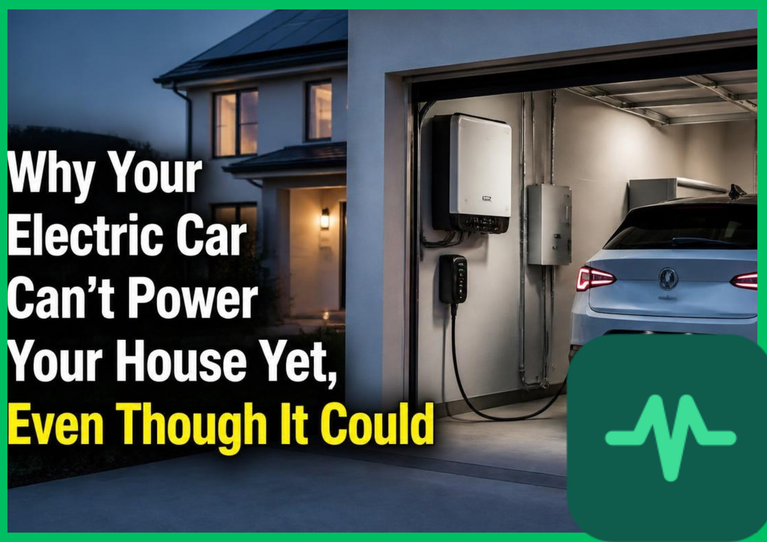
So why isn't this happening everywhere already? The honest answer has less to do with technology and more to do with policy.
What vehicle-to-grid technology actually is
Vehicle-to-grid technology, often called V2G, allows an electric vehicle's battery to send electricity back out, not just receive it during charging. This means your car could theoretically power your home, or even feed electricity back into the broader grid, when that stored energy isn't needed for driving.
The core technology enabling this genuinely exists today, representing a real, working capability rather than a distant, theoretical concept.
Why this capability feels genuinely exciting
Think about the practical implications. During a power outage, your electric vehicle could keep your home running for a meaningful stretch of time. During periods of high electricity demand, you could potentially sell stored energy back to the grid for a genuine financial benefit, then recharge later when demand and prices are lower.
This transforms an electric vehicle from simply a mode of transportation into a genuinely flexible, valuable energy asset as well.
The honest reason widespread adoption hasn't happened yet
Despite the technology existing, the regulatory landscape surrounding vehicle-to-grid capability remains genuinely fragmented and unclear across much of the world. Different regions have developed different, often incompatible rules, or in many cases, no clear rules at all governing how this technology can actually be used.
This regulatory uncertainty creates genuine hesitation among both manufacturers and utility companies about investing heavily in supporting infrastructure and vehicle capability, since the rules governing actual usage remain honestly unsettled in many places.
Why regulatory clarity matters so much here
Selling electricity back to a grid, even from your own vehicle, involves genuine technical and safety considerations that utilities and regulators need to properly address. Questions about compensation, technical standards, and grid stability all require clear regulatory frameworks before widespread implementation makes practical sense.
Without this clarity, manufacturers face genuine uncertainty about whether investing in V2G-capable vehicles will find a genuinely supportive regulatory environment allowing customers to actually use this feature meaningfully.
The honest state of vehicle availability
Currently, relatively few electric vehicle models genuinely support full vehicle-to-grid capability, even though the underlying technology isn't new. This limited availability partly reflects the same regulatory uncertainty discussed above, since manufacturers are naturally hesitant to build extensively around capability that customers may not be able to fully utilize everywhere.
This creates a somewhat circular, honest challenge. Limited regulatory clarity discourages vehicle manufacturers from broader investment, while limited vehicle availability reduces pressure on regulators to prioritize creating clearer, more supportive frameworks.
What progress is genuinely happening
Some initial commercial offers for vehicle-to-grid capability have begun appearing for private electric vehicle owners in certain markets, representing genuine, if still early, progress toward broader availability.
This early movement suggests genuine, growing recognition of this technology's potential value, even while broader, more widespread regulatory clarity and vehicle availability continue developing gradually across different regions at their own individual pace.
Why this matters beyond individual convenience
Widespread vehicle-to-grid adoption could genuinely help stabilize broader electricity grids, providing flexible, distributed storage capacity that helps manage fluctuating demand throughout each day, without requiring dedicated, separate battery infrastructure built purely for this purpose.
As more electric vehicles enter the global fleet, this potential distributed storage capacity represents a genuinely significant, largely untapped resource that could meaningfully support broader clean energy grid management challenges.
What EV owners can realistically do right now
If vehicle-to-grid capability genuinely interests you, it's worth researching what's currently available in your specific region, since availability and regulatory support vary considerably from place to place right now.
Some regions have made more meaningful progress establishing supportive frameworks than others, meaning your realistic options depend significantly on where you actually live, rather than purely on which vehicle you own.
A technology genuinely ahead of its regulatory framework
Vehicle-to-grid technology represents a fairly common pattern in emerging technology more broadly, genuine technical capability arriving before the regulatory and market frameworks needed to support its widespread, practical use have fully caught up.
This gap will likely narrow over time as more regions develop clearer frameworks, informed by early adopters and initial commercial offerings already demonstrating genuine, practical viability in specific markets currently leading this development.
The honest bottom line
Your electric vehicle's battery genuinely has the technical capability to power your home or contribute to the broader grid, but honest regulatory fragmentation and limited vehicle availability currently limit how widely this remarkable capability can actually be used.
This represents a genuine case of technology outpacing policy, rather than any fundamental technical limitation. As regulatory frameworks continue developing globally, this genuinely exciting capability should become more widely accessible, turning millions of electric vehicles into a meaningful, distributed energy resource beyond simply personal transportation.
Comments (0)
Login to leave a comment.
No comments yet. Be the first to share your thoughts!